Showing posts with label Art. Show all posts

Saturday, October 18, 2014

And so to bed: David Gissen's "The Mound of Vendôme" at the CCA -- with response


 I wrote this piece a couple months ago under commission from a fancy-pants art magazine. I submitted it and they sent it back, completely changing it around so that the piece ended up praising this ridiculous show and stressing its fundamental importance. As I couldn't disagree more strongly with that point of view, I just pulled the review entirely. This wonderful story about the installation of a giant butt plug in the Place Vendôme prompts me to share the piece here, which is probably the right venue anyway.

* * *


Like French lit, English litter derives from Latin lectus, bed. A portable bed or the stuff to make beddings, litter acquired its familiar signification—trash—by the 1730s. Such a bed made from trash was constructed by the Paris Commune on the place Vendôme in May 1871. Built of sticks, straw, and manure, this litter would protect surrounding buildings from a militaristic column erected in the square by Napoleon and toppled by the Communards on May 16, 1871. It is this same bed that David Gissen’s exhibition tracks and proposes to reconstruct.


Displaying thirteen prints and period photographs from the Canadian Centre for Architecture’s collection, the exhibition organizes time spatially. The first of four tables holds the earliest material: an engraving from 1822 depicting a sculpture of Caesar-like Napoleon, which capped the column. Reading left-to-right on each table, time is additionally indicated by black blocks with white characters dating the images—blocks cued to exemplify the column’s orientation. After May 16, 1871, the blocks align horizontally indicating the column has fallen, a miniature performance reversed on the penultimate table as the Commune itself falls and the column is re-erected. Imagined futures for the site show on the walls and a final table. Two light-box photographs offer digital renderings of the mound restored; black text reads against white gallery walls petitioning for reconstruction. A maquette of the column stands on the last table beside an odorless mound of “manure and organic moss,” which looks more like tobacco.


It is thus the exhibition makes its case for rebuilding this “earthwork” as a “counter-monument,” the latter phrase recalling a conversation about monuments and memory now some decades old. Stating terms in black and white, horizontal and vertical, the exhibition addresses the viewer as a reader asked to see the mound’s restitution as an inexorable conclusion to its story. However rousing a rhetorical strategy, this simplifying narrative also dashes past many of the key details. Absent from the gallery guide, for example, are names for several of the images’ makers and publishers—a disservice given the differences of interest they materialize so potently. If Bruno Braquehais’s 1871 photograph (above) suggests sympathy with its camera-facing guards who tower over the felled column, a page-spread from the Illustrated London News tells a different story. 

The column appears cocked at forty-five degrees, a huge wedge cut from its base. Ropes drape from its lantern as teams of men strain against capstan and windlass, mustering an encyclopedia of engineering techniques to gratify what this staunchly bourgeois newspaper called “the rage of the Communist Dictators.” More devastating is an albumen silver print from 1871 by Jules Andrieu shot gazing down to the bomb crater of the toppled column detonated in the square. Since he included this image in a series called Désastres de la guerre (following Goya, amending Callot), might Andrieu not have held a more complicated position than simply considering the demolition a “pointless act of irreverence towards the army, its leaders and veterans” as the catalogue glosses all dissent?

Most surprising is the proposed reconstruction’s vagueness. With what would Gissen remake the mound? His projections show plumes of organic matter. Yet, “part of the everyday ecology of Paris” (as Gissen describes it), the Communards’ mound audaciously wed practicality to sacrilege: receiving the toppled emperor in a bed made of litter from the modern street. Rather than anachronistically repeating hay and manure as the plans imply, why not use twenty-first century urban waste? Such a giant, festering mound would at least render under to Caesar the consumer detritus that is the by-product of the luxury retailers now ringing the place Vendôme. Asking them to lie in a bed of their own making would be a more pungent (if perhaps no more potent) gesture than this quaint, sanitized re-enactment.

[This post received the following response from David Gissen, dated Oct. 21, 2014]

I have to say that I have read many things about my work, but this is the first time I have ever felt compelled to reply. Besides your various points (a few of which I actually agree with), my desire to write this to you has to do with the anonymous way that you published this. You’re an editor of a major academic journal and a professor at a major university; so, in addition to the relative power those positions provide you in academia – places that have reviewed and published my work —I don't understand why you couldn’t stand behind this essay with full authorship.
To the various points you raised about our “ridiculous” exhibition:
In 2012 I was approached by the CCA to transform my petition regarding the Mound of Vendome into an exhibition. I believed that displaying my materials related to the petition in concert with the archival documents held by the CCA would be a powerful way to consider the archive’s relationship to experimental historical work. I agree with you that there is danger in instrumentalizing history towards some teleological message. If the exhibition conveys that the history of these events ends with the reconstruction of the mound, then I must work harder to separate archive and proposal in future iterations of this exhibition. In fact, when developing the renderings and model for this version of the exhibition, I tried to remove many signifiers that they were contemporary images – cars, signage, etc – so that they could potentially be seen as rendered reconstructions of the original.
You wrote that we did not identify the authorof the various images, but we clearly identified the author and source of each historical image in the accompanying booklet. I admit that I did not address the representational politics of Andrieu vs. Braquehais, among the other photographers and printmakers.  I am not necessarily interested in decoding the sympathies of the photographers towards the subject, but rather wanted to emphasize the quantity of representations of the events and their circulation. In the accompanying web videos I recall discussing the way the archival images circulated, which I think is more critical and in some ways worked against the authors’ original intentions. For example, Braquehais’ images were ultimately absorbed into anti-communard writings. And some of the most anti-communard photographs were republished by the Situationist International as illustrations of their pro-commune tracts.
As for your proposal to make the mound out of trash – that’s an interesting idea. But I see my project as situated within the history of urban landscape. We are witnessing an incredible moment in which historical urban landscapes are being reconstructed and renovated in contemporary cities and in many ways these establish narratives of urban history that I find troubling. I actually don’t see my proposal as a “counter-monument” – the staff of the CCA chose that term. Rather, I see my project as a “radical” landscape reconstruction. Not that the landscape of hay, manure and dirt is or was radical in and of itself (there were actually many constructions like it around Paris at the time and most were used as fortifications); but it is part of the radical history of the city that I hope to recuperate through the difficult politics of reconstruction.
As this project approaches realization perhaps there will be a way to address some of your comments above.
Thank you again and sincerely, David Gissen


Friday, June 1, 2012

My Grandmother's House

My grandmother died about a month and a half ago. In this photograph, taken the day after she died, I see some of the abiding features of her long, rich life. Take the yellow plastic telephone perched at the back of the wicker chair's seat, for example; it is one the many strange toys—the rusting metal trucks, the hairless dolls—she kept around in the event that children came by. Children were hugely important in her life; she worked with and thought about children constantly. Mother of four children, she collaborated on the reform of religious education after she finished seminary in the 1940s. She wrote numerous articles and several books about children and their confrontations with the kinds of questions traditionally answered by religion including her most famous book, which was in print for nearly sixty years. Although (as Mrs. Sanchez has astutely observed) my grandmother was one of the least overtly maternal people you could ever imagine, she took marveled at children and their ways. Putting an eye-catching prop like this yellow plastic phone well within their reach was sure to generate delights for her.

But, notice too how the seat of the wicker chair has been strengthened by a square of plywood. Born in Irish south Boston in 1919 and then made a child of the Depression, my grandmother hated to see things wasted. And, on the surface at least—that is, as here, on the outward-facing porch of her house—she liked to show that frugality with an aesthetic of practically-minded functionalism. If you think this plywood patching job is crude, you should have seen the knotted messes she made of my (fashionably) holey sweaters, which she often offered to darn.

I stress the outward show of this frugality as her house itself held a remarkable array of treasures. The story goes that many of the artifacts and the bulk of the library had been amassed by my grandfather's great uncle in late nineteenth-century Philadelphia. His ne'er-do-well children squandered his fortune and what remained of his prodigious collection of books and Arts and Crafts-era work (William Morris was a particular favorite, as this totemic portrait will suggest) was brought north by my grandfather's two spinster aunts in the 1960s. Amazing things remained; a Gutenberg bible, an invitations to Dryden's funeral, a letter of introduction for Gandhi. In the 1980s, an insurance appraiser found a Rembrandt print in the attic.


But, only to a keen eye would the loot that loot be visible. Typically, visitors would enter from the porch—by-passing the weird dolls, phone and busted trucks—into the kitchen where my grandmother would inevitably be seated by the soap-stone wood stove in her rocking chair. You would be ordered right back out of the house and into the garage to retrieve an armload of wood had you been so foolish as to come unprepared.

Inevitably, this would lead to some banter about navigating the Scylla and Charybdis that barred the completion of such tasks. As she had slowed down in later years—intermittently hobbled by a bad hip and then persistent shingles—she increasingly insisted upon "saving steps!" Doing so required contorting the body into a ruthless, Taylorist fantasy of totally efficiency of movement. However, saving steps was not to be taken so far that the would-be helper ended up carrying a "lazy man's load." Contrary to common sense (at least as I saw it), a lazy man's load denoted carrying so much that the job could almost be done in a single trip ... but would invariably go pear-shaped and require picking items up off the floor once dropped. I loved to tease my grandmother with the apparently contradictory instructions she dealt out as we tried to name precisely where a given load of wood fell on the step-saving/lazy man's load continuum.

As you may have guessed, precision, accuracy, getting things right were hugely important to my grandmother. If the hundreds of commentaries she read on her local radio station exemplify that conviction of voice, then this grimy fingerprints on her well-turned copy of Louis Leslie's 20,000 Words indicate the hard work—the commitment to craft—through which that clarity was achieved. Invariably, the public radio station would be on when I came into the kitchen. After running the gauntlet of the wood, she would tell me to turn the radio off. I would sit opposite her by the fire and she would start in with her standard, inquisitorial practice. When would I finish my dissertation? Would I ever get a job? Was I going to get married? How about children?

When I was a child myself, we would occasionally be received into the adjoining room to the west, the "fern room" (so-called on account of the wallpaper). That table in the lower right hand corner of the photography and the rotary phone used to flank the northern wall of the room. I remember my grandfather sitting in that chair, drinking a whiskey at holiday gatherings. 


Holidays were the only occasions when we were allowed to go into the formal dining room on the south side of the house. Prior to my grandmother's death, I never really had the opportunity to look at the silverware in the room. As a kid I was always too busy hustling dishes in and out of the room, refilling the water pitcher or keeping myself alert to this cruel game called "pig" that was sometimes played during the meal.

I realize now that many of these games were played with the silverware, but in a scrupulous effort not to see it as such. One such game involved an initiator performing a wondrous act of fiat whereby the saltshaker became "the cat" and the pepper-shaker became "the dog." One newly-minted animal would be passed ceremonially around the table clockwise, while the other moved counterclockwise. With every transfer of fauna, the carrier was required to introduce the relayed artifact by saying either "this is the cat" or "this is the dog." All of this was straightforward until the trajectories of cat and dog overlapped; two nearly identical, silver objects would descend from opposite side with relatives simultaneously declaring them to be household animals. The trick was to receive them both and pass them on appropriately without confusing their stipulated values. On this day after my grandmother's death, I was happy to have a moment to contemplate the silverware in its silence. Obviously, these pitchers aren't cats or dogs at all; they're geese.

Just west of the dining room is a formal entryway lined with portraits of long-lost relatives. My grandmother affixed index cards in the corners of many, as in the mustachioed gent at upper right. I don't think she ever troubled herself with the question of who painted these pictures. Then again, they are hardly masterpieces. But, the richness of pattern visible here—the gilt edging of the lacquered chair, the competing Anatolian carpets at right foreground and left middle-ground, the floral print of the wallpaper—this all spoke to me of a sultry, aging hedonism concealed behind the white-washed Yankee frugality of the house's front.
Walking through the house on that April afternoon, I was struck too by the glorious light captured in those far western rooms ...
... and by the baffling, distant books my grandmother liked to read: The Bible of the World, The World of Washington Irving. (In her defense, I doubt she ever read The Negro Caravan, which is second from left!)

What else is there to say that is not already latent in these images of her house? My grandmother was a great lady and a strange bird.

Tuesday, March 20, 2012

Printing as liquid technology

A good old story tells us that the volatile years of the late eighteenth/early nineteenth century represent a moment of explosive growth in the market for printed materials. Greater numbers of men and women in Europe were able to read. Participation in coffee house culture and other bulwarks of the "bourgeois public sphere" created avid desire for newspapers, pamphlets and other, far less learned printed materials. And, thanks to the rupture in censorship during the French Revolution, new, radical or just risqué printed materials were readily on offer.

But, that late Enlightenment period sees dynamic changes in printed form and content alike. Aiming to capture the dramatic contrasts of light and dark achieved in the famous "candle-lights" of his friend Joseph Wright of Derby, Liverpool experimental Peter Perez Burdett, for example, developed (well, he said he invented it, but ...) a method of aquatint printing. In Burdett's process, rosen would be distributed across a copper plate, then heated to form tiny chemical indentation in the plate capable of bearing ink, which would then be pressed onto the dampened paper to read as the dark, velvety textures necessary for rendering Wright's works. "Impressions chemically wrought" as Burdett's prints were described at exhibition in the early 1770s.
For the scale, speed and ease of production requisite to addressing modern mass audience, few period methods could rival the new technique of lithography. And, so that we could all learn more about liquidy processes of subtending that technique, our class made a visit to the well-equipped studio facilities at a nearby university. There, two graduate students (Hideki, who stands in profile on the left above, and Aanchal who appears in the photos below) gave us some practical demonstrations.

The crucial principle of lithography is the chemical resist between oil and water. Invented by musical-printing entrepreneur Aloys Senefelder in the mid-1790s, so Hideki told us, the traditional lithographic process requires a finely smoothed limestone surface, which can be treated for printing, then ground down and re-used. As you can probably guess from the examples on metal work table at left, these blocks are extremely heavy! Once the limestone surface has been made flush, the image-maker draws or paints onto the stone with oily media. As you can see from the example here, our class collaborated on this masterpiece using waxy crayons and a range of other mark-making instruments.

Throughout the process, reinforcing the resists between oiliness and wateriness is critical. For, after the ink is set out and prepared for rolling ...

... the print-maker applies a solution of nitric acid diluted in gum arabic onto the stone. As Hideki explained, the acid solution needs to vary according to the tonal qualities of the image. A higher proportion of acid should be mixed into the areas of the design that are to read as darkest. But, as we see at left, the application of acid and gum effaces the design.
Here, Aanchal is explaining how, for the process to work, the stone must constantly be kept wet as the greasy design attracts the oily printer's ink rolled onto the stone, while the untouched zones of the image retain their watery resist to the oil.
Here, Hideki and Aanchal are working together to keep the chemical action on the stone in order. First, Aanchal wets the stone with water. Then, Hideki rolls on the ink.
  
Next, a sheet of paper is affixed to the stone and rolled through the press. I think you can understand why everyone would want to get involved in the fun!


Here are some awesome examples of etched states from Aanchal's notebook.


Sunday, March 18, 2012

Liquid Courage

A camera is fixed on the beach, pointing out to sea where a small fleet of cargo ships sits at anchor in the middle distance. From the left-hand side of the frame, a man enters dressed in dark clothes. He iscarrying a red plastic bucket. Barefoot, he wades into the shallow, lapping surf, fills his bucket and walks back out of the picture-plane. So low is the camera's line of sight that we cannot see his head as he makes this exit. The screen then cuts to black, where we see the title of the work, Watercolor, reading in white text; a moment later, we see a textual blurb glossing the conceit unfolding before us. That is, the Belgian-born conceptual artist Francis Alÿs is creating his "watercolor" by mixing waters from the Black Sea gathered at Trabzon in Turkey with those of the Red Sea. And so, in the next shot, we seem to see the same male figure in his dark clothes, red bucket now entering the picture plane from the right and tossing his liquid load into what is identified as the Red Sea at Aqaba, Jordan. 

Alÿs's video is little more than minute long. The conceit, though, is that time and distance have been so compressed into filmic space that the water lifted from the Black Sea at the beginning is deposited into the Red Sea seconds later. The journey across Turkey, Syria and the length of Jordan—a route that Google maps refuses to compute, at least by my reckoning—is thus completely elided. Now, whatever playful, political or other point Alÿs may be pursuing in this video, his elision of that central, liquidy transit is precisely that which art historian Jennifer Roberts has sought to restore to attention in her celebrated, recent studies of colonial American painters like John Singleton Copley. Without rehearsing Robert's now well-known readings, I wonder how her account of eighteenth century watery space stands in relation to period texts, which often place the ocean in the register of the sublime. More to the point, if Alÿs's video (vaguely) gestures to possibilities for rethinking the massively under-theorized medium of watercolor, how might we understand the affect of the medial space of the ocean, which Roberts's work has so compellingly forward?

In his 1986 volume, The English Atlantic 1675-1740: An Exploration of Communication and Community, historian Ian K. Steele published the diagram at left. It is a bewitching image. Where conventional maps typically flatten the earth's watery expanses into a demure, monochrome blue, Steele's figure prints the human-inhabited continental landmasses in uniform grey (rendered splotchy here, alas, by my crappy scanner). Reading white on the bare page, Steele's oceans become vortices of drifts, streams, and currents within now-nameable aquatic places. Cued by the legend in the figure's lower right corner, those swirling curls of line also become legible as notations of currents' direction and temperature. British imperial interests of the long eighteenth century had to learn the vicissitudes of the terrifyingly-violent oceanic force if it was to be their collaborator.

But, Steele stresses, once we recognize that fact—once we see the ocean as a (quasi-)known domain to be sailed through, rather than a blue non-space to be flown over, we can appreciate the skill and scale of period navigational accomplishments. Steele makes this point with a brilliant anecdote: "In 1745 ... Cooper Thornhill of Stilton, Huntingdonshire, wagered that he could ride a 213-mile course to London and back in 15 hours. After he accomplished the trip in less than 12.5 hours, a contemporary recorded the following in amazement: 'This is deservedly reckon'd the greatest performance of its kind ever known. Several thousand Pounds were laid on this affair; and the roads for many miles lined with people to see him pass and repass.' This breakneck pace, which must have exhausted a number of horses as well as innkeeper Thornhill, was run at an average speed of 17.3 mph. ... Unless we can share their surprise, we cannot appreciate the communications of the period that preceded that ride." (Steele, 5-6)

In our readings for this week, we're asked to consider various ways in which watery spaces, oceans, were imagined in the eighteenth century—or how early modern watery space has since been imagined in film. And one of the obvious points of introduction to this conversation is the eighteenth century discourse of the sublime.
For Edmund Burke, a view out over a liquid expanse of the ocean is well capable of generating sublime ideas: "A level plain of a vast extent on land, is certainly no mean idea; the prospect of such a plain may be as extensive as a prospect of the ocean; but can it ever fill the mind with any thing so great  as the ocean itself? This is owing to several causes, but it is owing to none more than this, that the ocean is an object of no small terror." (Burke, 97) 

Contrary to the oceanic pathways and currents of Steele's map, the terror and sublimity of the ocean for Burke depend on their resistance to intelligibility—on its incapacity to be wholly grasped. “It is our ignorance of things," so Burke puts it, "that causes all our admiration, and chiefly excites our passions.” (Burke, 105; see also, 106; 118) That which is merely useful or merely knowable (see 108) completely eliminates the effect of the sublime. (Burke, 113, esp. 114) Water thus factors into Burke’s thinking on the sublime in interesting ways. Beyond the prospect of its oceanic immensity, water when falling can generate a kind of overwhelming mental seriation: "After a long succession of noises, as the fall of waters, or the beating of forge hammers, the hammers beat and the waters roar in the imagination long after the first sounds have ceased to affect it." (Burke, 130) This aural "after-image," as it were, induces a contemplation of sublime infinitude. Further, hearing the sounds of these massive falling waters is so overwhelming an experience that the subject's sense are almost compelled by a kind of sympathetic resonance to join into the rhythm. (Burke, 151)

For Kant in the Critique of Judgment, however, it is entirely wrong to describe specific natural objects like the vast ocean heaving in storms as sublime. This is because the impression of that scene is merely horrible. But, the sublime is not in those sensations; instead, the effect of the sublime is a reflective judgment in the mind. (Kant, 99) So, the feeling of the sublime is initially unpleasant as the imagination struggles to present sensation to reason; but it becomes pleasurable as the reason generates a feeling of purposiveness out of conflict. (Kant, 116) The pleasure of the sublime lies not in nature or sensory presentations but in the subject’s recognition of power within himself, in the unlimited ability of reason. Kant makes this point by again evoking the sight of the seas thrown up in terrible storms: 

"Though the irresistibility of nature's might makes us ... recognize our impotence, it reveals in us at the same time an ability to judge ourselves independent of nature, and reveals in us a superiority over nature that is the basis of a self-preservation quite difference in kind from the one that can be assailed and endangered by nature outside us. ... Hence nature is here called sublime merely because it elevates our imagination, making it exhibit those cases where the mind can feel its own sublimity, which lies in its vocation and elevates it even above nature." (Kant, 121)

So, in the blast of mist thrown up by the ocean's storm, it is as if the subject is able to perceive not the power of nature, but of her own reason. There is very interesting room for comparison between the quasi-narcissistic image of the subject’s own powers grasped in the ocean storm and that (deadening) self-image perceived by Narcissus in Poussin’s Birth of Bacchus discussed here. However, the key point is that, rather than overwhelming and stupefying human intellectual capacities qua Burke, the sublime in Kant’s sense is pleasing as a glorification of intellection. While certainly, Kant allows, there are those rustic peasants who have no capacity for the reflective pleasure of the sublime at all (Kant, 124), contemplation of sublime and beautiful effects can serve as a propaeudeutic to higher realms of philosophy. He puts it this way: "The beautiful prepares us for loving something, even nature, without interest; the sublime, for esteeming it even against our interest (of sense)." (Kant, 127)


Some sense of this bleeding between natural and human power—maybe even of the beautiful and the sublime—is materialized in Kenneth Anger's Eaux D'Artifice (1953). Set in a sixteenth century space (that of the gardens of the Villa D'Este at Tivoli), the protagonist in Anger's film appears to be dressed in the high fashion of the 1780s-90s with elaborate ostrich feathers in her hair, which merge into the jetting plume of water in the films opening and closing sequences. So, with our human's animality clearly foregrounded, we see this character running through the gardens, her movements sometimes following the gravitational descent of the water as it trickles down through the garden's elaborately constructed eddies. Indeed, as is nicely captured in the frozen still above—where we see the parabolic arch of upward-projected water splintering at left into falling, liquid fragments—the film highlights tensions between natural directions of flow and the implicit artificial contrivances needed to control and to propel water. 

Thus, we might conclude, rather than docilely commanding nature like the cargo ships at anchor in Alÿs' film or upwelling within us in the face of nature's fury per the Kantian sublime, human power is dramatized in Anger's film as a fraught project. Beset from within by our own animal characteristics, human power requires a collaboration with nature that can be both beautiful but terrifying in its own right when—like the pulsing, jetting fountains—it seems to take on a life of its own.

Wednesday, March 14, 2012

Liquid Power

In last week's readings, we considered Thomas Willis's incredible conception of blood being heated and pumped up from the heart, through the body like water through a fountain. Warmed until they separate from the mass of the blood, the animal spirits act for Willis both as purveyors of life and as the medium of thought insofar as they can be impregnated with impressions of species propagating from objects in the sensory field. Circulation, a concept drawn from William Harvey's then-recent physiological studies, thus acts for Willis as the substrate for understanding intelligence and its liquidy forms.

But, as the reading for this session by literary scholar James Thomson shows, metaphors of circulation were also readily taken up by British political economists who aimed to understand the nature of money and its relation to wealth. The story that Thomson tells follows two major shifts in a general movement toward liquidity as circulation of currency comes to be seen as a means of nourishing economic growth as a river does parched land. (Thomson 71; 75) First, Thomson traces a "dematerialization" story—a shift in the conception of monetary value from a "materialist" notion focused on the weight of bullion to a "nominalist" position wherein money is only a sign for the denomination printed on it. Value becomes radically detached from the material of the currency itself. (Thomson 43; 77-8; 83) Secondly, Thomson argues for (although he does less to demonstrate) a shifting conception of wealth as treasure, which should be buried in the ground at the least sign of market instability or military threat as Samuel Pepys does in the later 1660s, to money seen as capital—as a means for producing more wealth through circulation. This point comes across most powerfully with Adam Smith where the wealth of nations lies not in its hoarded coins and currency, but in the goods and production it generates annually. (77-8)

But, how might we understand this conception of "liquid" values and capitalist circulation in relation to the royal/aristocratic flows described by Meredith Martin? Are the "economies of flow" detailed by Martin in her recent study of ancien régime pleasure dairies (such as that at Versailles at left) and their rituals performances of milk-pouring coextensive with the Lockean pastorals described by Thomson? That is, in Thomson's telling, Locke advances a theory of coinage whereby weight equals monetary value; he is strongly against paper money and bills of credit. For Thomson, this is all apiece with a "conservative," aristocratic agenda that seeks to emphasize an image of stasis, continuity and tautological identity above all. "Silver is silver," in Thomson's paraphrase of Locke; aristocratic privilege begets aristocratic privilege. (Thomson, 61-1) Yet, in the Absolutist context described by Martin, patriarchal authority is asserted by ritualized performance of liquid pours. Visible only to his most privileged courtiers, the milk Louis XIV pours in his laiterie stands in as much for his fertile semen as for the purity of the blood running through the French royal line. (Martin 74-5; 86-93)

Flows of money and flows of patrilineal, bodily fluids are brought together in truly ghoulish ways in the person of Noah Cross in Roman Polanski's Chinatown (1974). Especially in the last scene at Evelyn Mulwray's house (from which the still at left is taken; see ca. 2:00:30), private detective Jake Gittes lures Cross to his daughter's house to swap money (by phone, Gittes asks "do you have your checkbook ready?"; so, he's not even getting paper currency—let alone bullion—but a bill of credit) for Cross's daughter who, though incest, is also his grand-daughter. Cross's is no exogamic kinship, let alone a bourgeois model of political economy that takes value from the circulation of its currency. Instead, his is a straight, "pure" line of genetic material. Like the grail legend by which Polanski was partly inspired, the grail is not an object, but a person, a flow of pure blood from Christ to the future.

We are deep in religious waters here. Like the maimed, dying Fisher King of the grail story, Polanski's Cross is frail; he walks with a cane and reads with bifocals. (Indeed, these are the glasses that incriminate him in the murder of his ex-partner, Hollis Mulwray, after Gittes finds them in the salty "tide pool" in the backyard). Where the Noah of the Bible commands the waters of the Flood, Polanski's Noah holds court at the Albacore Club; a massive tuna is its ensign. Yet, we're mistaken if we conflate the flows of currency through which Gittes reads (or, more to the point, repeatedly misreads) motives for action and the drift of Cross's intent. When confronted by Jake in this scene by the pool, after all, Cross scoffs at the idea that he wants money. What does he want? "The future! The future, Mr. Gits"

So, to bring this all together, I wonder if we might use Chinatown to articulate two kind of power-flows in the early modern context. First, we have the rising middle class model with its complex instruments of credit, its paper currency, etc., that all serve to dematerialize value—to release it from mere weight and to relaunch it as capital that generates wealth through circulation. Second, we have the older "aristocratic" model in which milky, bodily fluids are carefully guided through highly-prescribed channels to reproduce the same, tautological result over and over again. Silver is silver, aristocracy is aristocracy, Cross's grail/blood is Cross's grail/blood into "the future!"

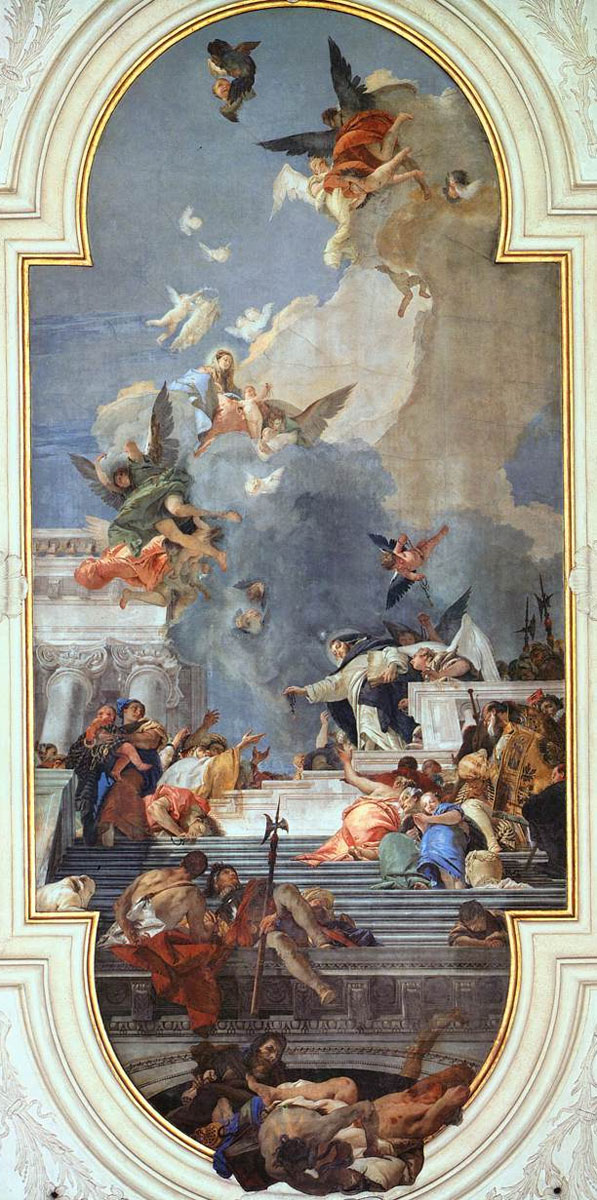
All of this might be related to Tiepolo in the telling of Svetlana Alpers and Michael Baxandall in subtle but compelling ways. At the most direct level, we could say that Tiepolo possess complete command of the watery elements of his medium, executing wash drawings with an almost athletic brilliance. (Alpers/Baxandall, 51-3; 58) However, the real target of the authors' investigation is a "pictorial intelligence" that exceeds this mere material wetness and expands it into a fluid aesthetics of mobility and light. These points come across most powerfully at the end, where one of Tiepolo's greatest successes—a harnessing of light reflecting off the watery canals onto his ceiling painting, seen at left, at Santa Maria dei Gesuati in Venice (Alpers/Baxandall, esp. 84-88; 92)—is contrasted with his failures at the Venetian Palazzo Labia. There, his design is described as inhibited, paralyzed and incapable of bringing the "fluid potential" (p. 94) of Tiepolo's sketch into the domain of the mobile light and moving viewer needed for his art. (p. 97)

So, although this work by Alpers/Baxandall seems (intentionally) ahistorical, is there a way in which we could draw a historical relation between Tiepolo's privileging of a circulating, mobile beholder and his general, "liquid" aesthetics with the Smithian/political-economic conception of money (also coming into realization in the mid-eighteenth century), which acquires value only as it moves?

Tuesday, February 14, 2012

Fossils, Photography, Painting

In his contribution to Jim Elkins's volume Photography Theory, literary critic Walter Benn Michaels takes a claim from Hiroshi Sugimoto (whose Devonian Period, gelatin silver print of 1992 we see at left) whereby photography stands in some meaningful relation to fossils. Neither are, so this claim goes, only  representations. And perhaps, as Michaels suggests, neither are representations at all. Fossils and photographs are both made from objects such that those replicated targets become "causally indispensable" to the resulting petrification or chemical image in ways that are simply irreconcilable with pictorial techniques like painting. (Michaels, 432) While a broader aim of this course is to problematize the model of photography that Michaels has in mind, the preliminary question for today is: what does this assertion assume about fossils? More to the point, following on from what we saw last week with Boschini and his delight in the distance of Titian's stains and marks from intentionality, how plausible is the conception of painting to which Michaels is juxtaposing his conception of the fossil/photo?

As a way into those questions, we began with two early modern texts on those artifacts we know now as fossils. For Nehemiah Grew (from whose Musaeum Regalis Societatis [1681] the images at left are taken), Michaels's contention that fossils need some prior object to transform would have been highly tendentious. While he acknowledges that it is fashionable to claim that fossils are natural bodies petrified, Grew also asks: why might we not imagine that that Nature has redeployed the "plastic virtue" by which terrestrial bodies are normally formed, but done so in the colder, wetter bowels of the earth for fun? (Grew, 254) After all, if comparable techniques of embedding "pictures" into stones could be practiced by contemporary artisans (as the piece we read from the Philosophical Transactions of the Royal Society of London shows) and if so-called fossils could be dissolved in acid (Grew, 267), then surely the higher artifice of Nature could produce these marvelous sports. Grew puts it this way: "There can be no convincing Argument given, why the Salts of Plants, or Animal Bodies, washed down with Rains, and lodged under ground; should not there be disposed into such like figures, as well as above it? Probably, in some cases, much better, as in a colder place; and where therefore the Work not being done in a hurry, but more slowly, may be so much the more regular." (Grew, 254) 
  
Contra Michaels, then, objects in the world only appear to be "causally indispensable" to fossil-production. In fact, Nature  is just playing games—an idea with an extensive early modern pedigree. Curiously enough, though, Grew also goes on to compare the manner by which these "pictures" of natural forms get embedded into rock with what he calls images "cast through a Glass (as Kepler shews the way sometimes of taking Landskips) upon a Tablet in a Dark Room." So as with Michaels, we might say, Grew ends up likening camera-(obscura)-based image-making to fossils anyway. 

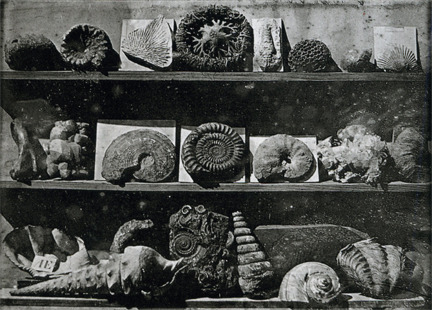
Contemporary to Grew, Robert Hooke took a radically different position on fossilization. The sea shells found on the tops of mountains were, he contends, once lay at the bottom of oceans. (Hooke, 324) If incredibly hard rock like flint was once so fluid that it could envelop shells, then the earth must be massively susceptible to radical changes. Indeed, Hooke continues, a model of the created earth organized around the governing influence of gravity would be an onion-layer system with the densest metals at the core and lighter materials grouped like-to-like progressively outward toward the periphery. This, Hooke explains, is why gold is so often found in mountains, where the forceful violence of earthquakes has forced subterranean materials upwards. Unlike Grew, then, there is no space for nature to playfully represent her standard form in the cold, wet space of the earth; indeed, the earth is not cold and wet at all for Hooke. Instead, the reason that we find fossils like the ammonites at left is that they have been petrified and then thrust into the earth through Nature's convulsive violence.

Thomas Willis's conception of the means by which the material body and the incorporeal soul communicate are among the closest engagements with "liquid intelligence" to be found in the seventeenth century. Drawing from optics, alchemy, mechanics and extensive anatomical research, Willis explains how the blood is heated and rarefied into animal spirits, then blown upward like a fountain through the fleshy folds of the brain. Unlike chemical liquids, though, the animal spirits can carry with them representational information ("Images of their Objects") by which the faculties of the soul are informed of data perceived by the senses. And these swirling liquids interface with the soul in a truly remarkable piece of visual projection in "the inferior Chamber of the soul, glased with dioptric Looking-Glasses; in the Penetralia or inmost parts of which, the Images or Pictures of all sensible things, being sent or intromitted by the Passages of the Nerves, as it were by Pipes or strait holes, ... are represented upon the Callous Body [of the Brain], as it were upon a white Wall; and so induce a Perception, and a certain Imagination of the thing felt." (Willis, 24-5) So, the blood is filled with images which the soul can see once projected onto or through the hermetic glass casement that surrounds its seat in the watery depths of the brain. Because these images are then saved by the soul, they become the basis for rational thought and reflection. 

Photo-sensitivity is central to the accounts of William Petty and William Cole, who also links it to fossilization. Petty begins his account of dyeing (published in Thomas Sprat's 1667 History of the Royal-Society of London) by emphasizing how central to the study of light would be to any exhaustive understanding of liquid dyeing practices. (Sprat, 284-5) Petty then goes on to demonstrate how material supports need to be prepared to receive dye (see Sprat 290), and much work is required "to fix" the dye's coloration. (Sprat, 302-3) Cole, meanwhile, takes a delight as much in his capacity to fix color as to observe its temporal evolution. In his correspondence on shell-fish dye from the mid-1680s, Cole sets out a complex account of the times of year when the dye can be fashioned—the season in which the shell-fish can be harvested and how long their innards need to be exposed to the sun to make images. (Cole, 233) He takes great delight in juxtaposing fossils (a specimen of which he claims "will puzle Mr. Hooke and the rest of the ingenious Gentlemen who will have them to be petrified shells of fishes"), which seem to be painted by Nature (along similar lines as that of Grew), with his photosensitive dye, which is painted by hand but then transformed by the sun.

What can we conclude from all of this? Well, first off, Michaels certainly moves in a venerable tradition when he likens camera-made images to fossils. Whether or not objects "cause" their images to be made in either domain, a central theme in this collision holds that human agency or intentionality is somehow put into abeyance when these visual forms are generated. Nature is playing games. Or, if a human intervention is required to ready a chemical support or to provide an optical projection, it is the sun that then does the work in making an image appear in time. Now, if all this flies in the face of the ideology of artistic nobility promoted by Poussin—if this solar agency departs from the dark, sunless spaces commanded by the masterful maker of oil painting in van Mander's narration of Van Eyck—it seems to how close to the model of Titian's painting and period reception described by Philip Sohm. "Venetian painting," as Sohm puts it, describing Marco Boschini's views, "is a 'form without form, or rather form deformed'; it finds its 'true formation in fluid form.'" (Sohm, 124) How, then, do we explain this persist conception of painting (to which Michaels clearly subscribes; see 444) as a pure exercise of human will and intentionality whereas photography—like fossilization—is mired in a quasi-magical domain of objects that make their own images?
 

Friday, February 3, 2012

Coagulations


One of our themes from last time was how attempts to reckon with the liquid image often collapse  elevated, artistic vitality and corporeal abjection. It is as if the image with a "life of its own" often has back hair! If Benvenuto Cellini (in Michael Cole's) account succeeds in ennobling the seemingly menial task of bronze casting and, thus,  enfolding Renaissance Florence's supreme masters of marble sculpture into the fictional field crafted by his medium, he does so by imagining the flowing pour of molten bronze as a cascade of coagulating blood. Where Albrecht Durer extends the project of Jan van Eyck still one stage further in Joseph Leo Koerner's telling by claiming authorship for an image "made without human hands" (acheiropoieton) and then representing the face of God with Durer's own features, he does so by modeling that picture upon an image made from sweat—the mythical sudarium or veil of Veronica. As Karel van Mander's historical account relates how Jan van Eyck's incredible oil paintings were sniffed and smelled by Italian painters not yet in on his alchemical secret, Jim Elkins admits that the painter's bewitching materials nevertheless bear an undeniable similarity to excrement. And as he crafts his entrancing, Sisyphean project of liquid picture-making (see above), Oscar Muñoz does so by throwing it down on the sun-baked pavement where it constantly loses form "like a spider or spit."

Our readings for today asked us to take a decidedly higher, drier road. They ask us to meditate upon the dangers of the watery image or, more to the point, of the images made by water. In Richard Neer's reading of Poussin, the dying figures of Narcissus and Echo are chastening warnings to the followers of Caravaggio who would simply copy appearances or "aspects" of nature rather than engaging in Poussin's emulative model of classicizing invention from imitation—the active appropriation and recombination of a variety of motifs from learned sources. (Neer, 274; 275; 277-8) That model is figured in and around the god Bacchus who is being reborn in the picture's darkened grotto. So, this God of Wine reborn is the living, vital image of true painting; but, if we expect him to appear optically wet—to render visible those outward trappings of his liquidity—then we are but in thrall to that pernicious, flattening of art into the mechanical replication Poussin saw in prints. (This reading might finally help me to work past my loathing of the arid, ascetic dryness of Poussin's paintings!)

Eve too, in John Milton's telling, is confused about which image tradition to follow. Adam's image, made from his flesh and blood, she awakens and espies a bewitching, lovely presence in the "liquid plain" of Paradise's pool. But, unlike Echo to Eve's feminine Narcissus, Adam can actively call her out of her reverie, alerting her that this is but her own reflection she sees. Appealing to something like Poussin's internally-differentiated, imitative tradition of reproduction, Adam encourages Eve to turn away from her own water-reflected image and embrace "he / Whose image thou art, him thou shall enjoy / Inseparably thine, to him thou shall enjoy / Multitudes like thyself, and hence shall be called / Mother of human race." (Milton IV, 471-475) Like Hari in Tarkovsky's Solaris, Eve has been made from Adam by an intelligent agent—God, in the case; not a watery planet. Yet, offered this prodigious, replicative order, she resists. She turns back to the softer, watery image she originally saw in the pool.

This capacity of the pool to transform the luminous world into an image more compelling than itself is given interesting treatment by Bachelard: "It then seems as though contemplated nature helps in the contemplating. ... Is it the lake or the [human] eye which contemplates better? The lake or pool or stagnant water stops us near its bank. It says to our will: you shall go no further; you should go back to looking at distant things, at the beyond. While you were wandering, something here was already looking on. The lake is a large tranquil eye. The lake takes all of light and makes a world out of it." (Bachelard, 28) Clearly, this is treading similar ground to Housekeeping; but, it also makes fascinating address to Poussin who defines painting as " 'an Imitation with lines and colors on any surface of all that is to be found under the sun.'" (Neer, 274) Yet, Poussin represses from his Birth of Bacchus the figure he had planned of the Sun God Apollo. (Neer 278-9) Why?

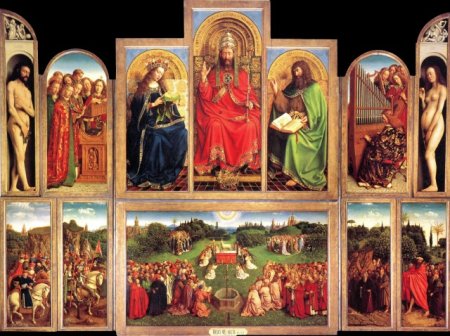
How might Bachelard's curious comment that "in Bruges, every mirror is stagnant water," help us to understand Lucas de Heere's praise poem whereby the Ghent altar piece is both a mirror and the sea? (Van Mander 62) How does the solar scope of painting for Poussin compare or contrast to the antagonism between the sun and the unctuous image for Muñoz and for Van Eyck? (57) Does the scabby surface of the stained Venetian picture according to Sohm problematize the portrait of liquid generativity painted by Neer? Let me get back to you on that one.


Saturday, January 14, 2012

Hunters in the Snow


Have you seen Solaris? No, not the George Clooney version. I mean the 1972 Soviet classic directed by the great Andrei Tarkovsky. You remember the story; Kris Kelvin, the troubled-looking gent in the still shot above, is sent to a space station to investigate a mission that has gone all pear-shaped. The scientists on the mission are supposed to be researching a watery, ocean planet called Solaris. But, their research has produced strange findings. When Kelvin arrives on the ship, he discovers that things have indeed gone awry. The ship is a mess, one of the scientists has killed himself and mysterious, unidentified visitors are seen and heard flitting through the corridors.

With his colleagues are cagey about these details, Kelvin awakens to find that his dead wife, Hari (who we seat seated on his lap above) has re-appeared. Is she purely a product of his imagination? A delusion? She is seemingly impervious to destruction; when she is wounded, she heals rapidly. When she is ejected from the ship, she just returns the following night. Kelvin comes to understand that she is a non-human replication of Hari harvested from his memory by the churning waters of Solaris and materialized from neutrinos.

At the same time, this non-human Hari—a hybrid fusion of Kelvin's memory and the sentient ocean—begins to gain self-conscious. Initially, Hari is unable to remember the past; she can't identify herself in a framed photograph that Kelvin brings from Earth. Slowly, she differentiates herself from the terrestrial Hari, who persists only in Kelvin's memory and his photographs, and she takes on a life of her own.

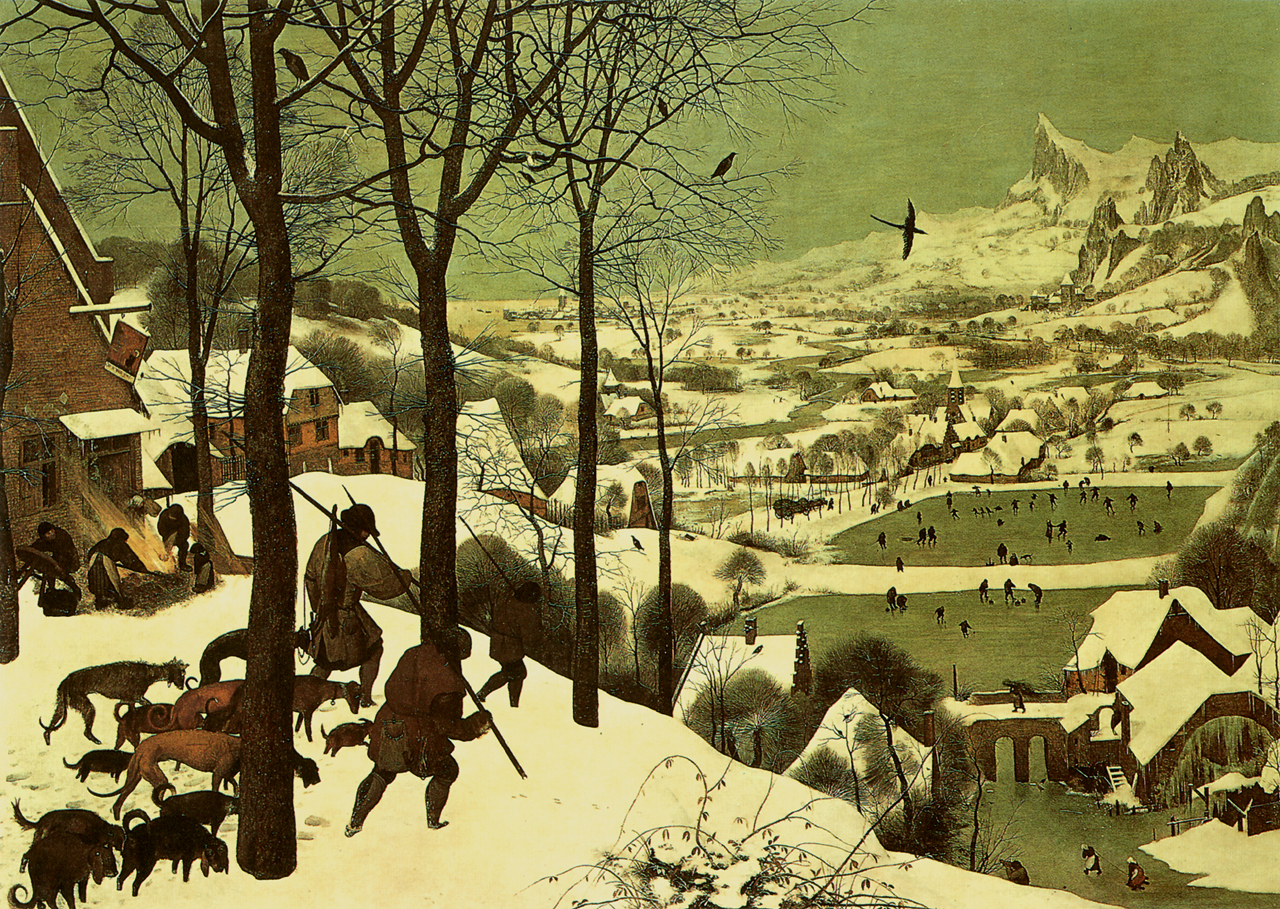
A very interesting visualization of this sentience then unfolds as we see Hari gazing upon the painting above: Jan Bruegel's Hunters in the Snow now in the Kunsthistorisches Museum, Vienna. A hunting party and a pack of hounds have entered the picture plane from the left as they descend snowy hillside toward a village. The pair of small lakes in the valley below have frozen solid. Silhouettes of skating adults and children flit across their surfaces. Craggy peaks sprout from the hillside beyond the pooled lakes as a single, darkened bird descends across the leaden sky.

Now, since Tarkovsky cuts between a shot of Hari looking at this image and a sequence of close-ups of the picture itself, we can infer that these shots offer us her point of view. The camera tracks slowly across the picture-plane, panning in and focuses upon specific, seductive details. And, as it does so, the film cuts to a scene of Kelvin as a boy playing in the snow—a scene from a film that Kelvin had previously shown to Hari. What we seem to be seeing, in other words, is this non-Hari's evolving capacity to make associations between perceptual data and mnemonic information. She says as much to Kelvin who calls her out of her reverie when she confesses that she has been "lost in my thoughts." If made from his mnemonic storehouse by Solaris's intervention, this hybrid non-Hari is beginning to take on a life of her own, to think for herself. If the scientists have been trying to study Solaris as Solaris has been trying to study them, it tempting to think of Hari's own consolidating consciousness as that frozen membrane of ice that separates the skaters from the chilly depths beneath. I'll need to come back to this topic later.

Monday, December 12, 2011

Clever Clogs


In case you were wondering, I am working on an introduction for a project I began working on in 2008. The project has a publisher, but it won't be coming out until 2013. Would that this were some kind of unbelievably long delay for an academic project. Alas, it is not.

Well, as a key term from this priceless dialogue figures prominently in my thoughts for—and, it has to be said, about—this project, I thought I would share it with you, dear Blog. Now, back to it!

Love,

Sanford Sanchez


Sunday, December 11, 2011

A love-letter to Blogging

Dear Blogging:

Where have you been all my life? I am afraid that I have neglected you. Well, what with Facespace and other forms of communication ... it seems like the days when I would sit down to write a good long blog that really expressed all of my important feelings are just a little old fashioned.

Well, Blogging, you can call me an old fogey if you want, but I'm going to be going through some difficult challenges in the next couple weeks. And, I just wanted to know that I may indeed be calling upon you for some moral support.

First of all, I am pleased to let you know that I have finally completed the forth and final component of the "group portrait" series. Hopefully, I will get Penelope in the mail tomorrow. I know her recipient will be surprised. Just in time for the holidays!

But, who is that lurking over in the corner? I don't know him! Yea, it is true. He may be a friend of a new kind, I am afraid. Meet Mr. Winter Jacket. Let's hope he is not a Hic Jacet, if you catch me drift.

Love -

Sanford Sanchez


Thursday, July 14, 2011

... in which we remember why Sanford Sanchez is not an artist

Many moons ago, yours truly -- Sanford Sanchez -- was an aspiring artist. Art school, beret, black clothing: the whole deal. Without exaggerating the merits of my art, making the work was extremely satisfying. But, how to make a living doing it? This was a bit tricksy. As you know, I moved to New York right after finishing undergrad where I had that ridiculously low-paid internship. Many of my art-school friends were there, but what they were doing as "art" was not exactly up my street. So, although I found myself at a bit of an impasse then and took a different route, I've often tried to find ways to keep on making things if only for my personal amusement.

Now, one such project along these lines is called "Flatpack Friends" in which I make friends, literally, out of cardboard and mail them off to humanoid friends, often at some lonely outpost in the back of beyond. So, driving home the other day, I happened to see a stack of these cardboard boxes. What to do with them, though?
One of my more humble creations of late has been this "scare owl," which would theoretically keep the raccoons and squirrels out of the vegetable patch. Totally ineffective, and also increasingly sad is this owl now that he has been repeatedly "softened" by the sprinkler system. Anyway, seeing the boxes and looking at the owl made me think about feathers. It would be cool, I thought, to make something vaguely to do with feathers.

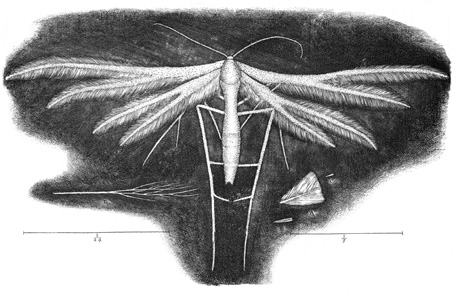
So, while I had started to fumble around with ink drawings of bird wings—the pictorial model I had in mind being the wings of Caravaggio's Amor Victorious—I quickly reconsidered. I wasn't aiming to produce a beautiful drawing of feathers; what I wanted was a cool cardboard object. Within seconds, I had found an awesome image online of magnified feathers, which I then tweaked, flipped and combined in Photoshop.


Then, around 11 PM (Point #1 toward my title) I ran over to campus where I taped the cardboard box to the wall, hooked the computer to the beamer and traced the design onto the box with a marker. That took about two hours last night. Good fun!
I had a hard time sleeping last night, in part because I was so eager to keep working on this project. (Point #2 toward my title). So, first thing this morning, I took the delineated box out back and started painting in the background in black. All of that looked pretty cool. The palette of black on tan, however, was a little too close to "the day job." And I had been planning to use three colors anyway—well, two colors of pigment plus the tone of the untouched cardboard.
However, once I had watered down this acrylic burnt sienna to the liquidy texture I was looking for, it became this insanely orange hue. Hmm. That was not exactly the palette I had had in mind. And the more I painted in the mid-range, veinous patterning of magnified feather-fibers, the more I had associations with tiger-stripes, psychedelia, etc. Blech.

The only way I could think to save this—note the missionary fervor (Point #3 toward title!)—was by complicating the excessively simplified figure/ground relationship operative to that point. It just wasn't interesting visually to have these thick, uninterrupted cordons of bare cardboard with black and burnt sienna demurely cowering in their circumscribed quarters.

So, this meant inventing some centralizing light source that would bind the image as a whole (even though composed of the same image mirrored horizontally) and then using the orange as a fictive "shadow" on the underside of these feather fronds. (Curiously enough, this also reminded me of a strange painting I had done back in the day). Because I was spinning the box around on the table on our back porch, it created all kinds of cool drips and so on. But, I was also getting low on paint, the flies were coming out and, back to the title of this post, I was becoming incredibly obsessed and massively frustrated that I just! couldn't! get! it! right! with this project. An admittedly frivolous project, mind you, on a worthless piece of cardboard box that I'll mail to a friend to use as his leaving trunk!

So, an episode like this may serve to remind us why Sanford Sanchez is not who he used to be. Not that there was anything wrong with that young artist at left. But, the lack of sleep; the obsessive, unrelenting fixation on very specific visual problems; the absolute commitment to those problems and the exclusion of most other things ... well, those may be good solutions for other people, but this Sanchez needs to live by a different code. I'll tell you what.