Showing posts with label Death. Show all posts

Monday, November 19, 2012

Risky Business, Business as Usual

Meeting our group last night, Fiona Annis welcomed us into her "live/work" space in Griffintown for a memorable introduction to the art and science of wet-plate collodion photography. As suggested by the impromptu portrait session depicted above -- Jeff donning a fur, Fiona lighting her target as the rest of the group looks on, slightly stunned -- the spirit of "making do" or bricolage in the Levi-Straussian vein would seem to be central to Annis's practice. A credit card has been bent to hold her aluminum plates in place inside the gerry-rigged plastic cartridge she attaches to a thrift-store camera. An ice-fishing tent draped with light-blocking cloths becomes her portable darkroom. And the accreted condensations of silver crystals on and around the corners of her plate holder become the noisy artifacts of her photographic images.

But, how much of these menaced, compromised or otherwise accidental mutations can really be explained by the "inevitable" constraints of those improvised situations? That is to say, Annis's own attractions to sublimity, darkness, and a Surrealist-informed aesthetics of monstrosity feel much more compellingly present as the gravitational force propelling these occasions for decay. As we canvassed her collection of dripped candles, books on the art of Joel-Peter Witkin and other items worthy of what Restoration poetaster Ned Ward called a "Ware-house of Egyptian Mummies, old musty Skeletons, and other antiquated Trumpery," we heard tell of her friend's 32-page suicide note as "an extraordinary document." We saw her images of sites of famous, melancholic deaths. We smelled unfurling around us the pungent odors of the highly toxic ether, collodion and silver nitrate requisite to this procedure with which she works and sleeps

Annis claimed at one point that her art aims for "a sense of meaning without actually making sense." Wet, wooly and intentionally designed to court visual danger, I think there actually is a very clear way in which it does make sense—as a risk-seeking indulgence of a full-throated death drive. Fluid this work surely is in its material making. Liquid it may be in its squishy, morbid reflections. But, is it intelligent? More broadly, does an account of liquid intelligence need to breed in the dark, marshy backwaters of this plangent lugubriousness? Or might we model its movement—as with Fiona's posing of Jeffacross the face of brighter, lighter surfaces?

Saturday, January 14, 2012

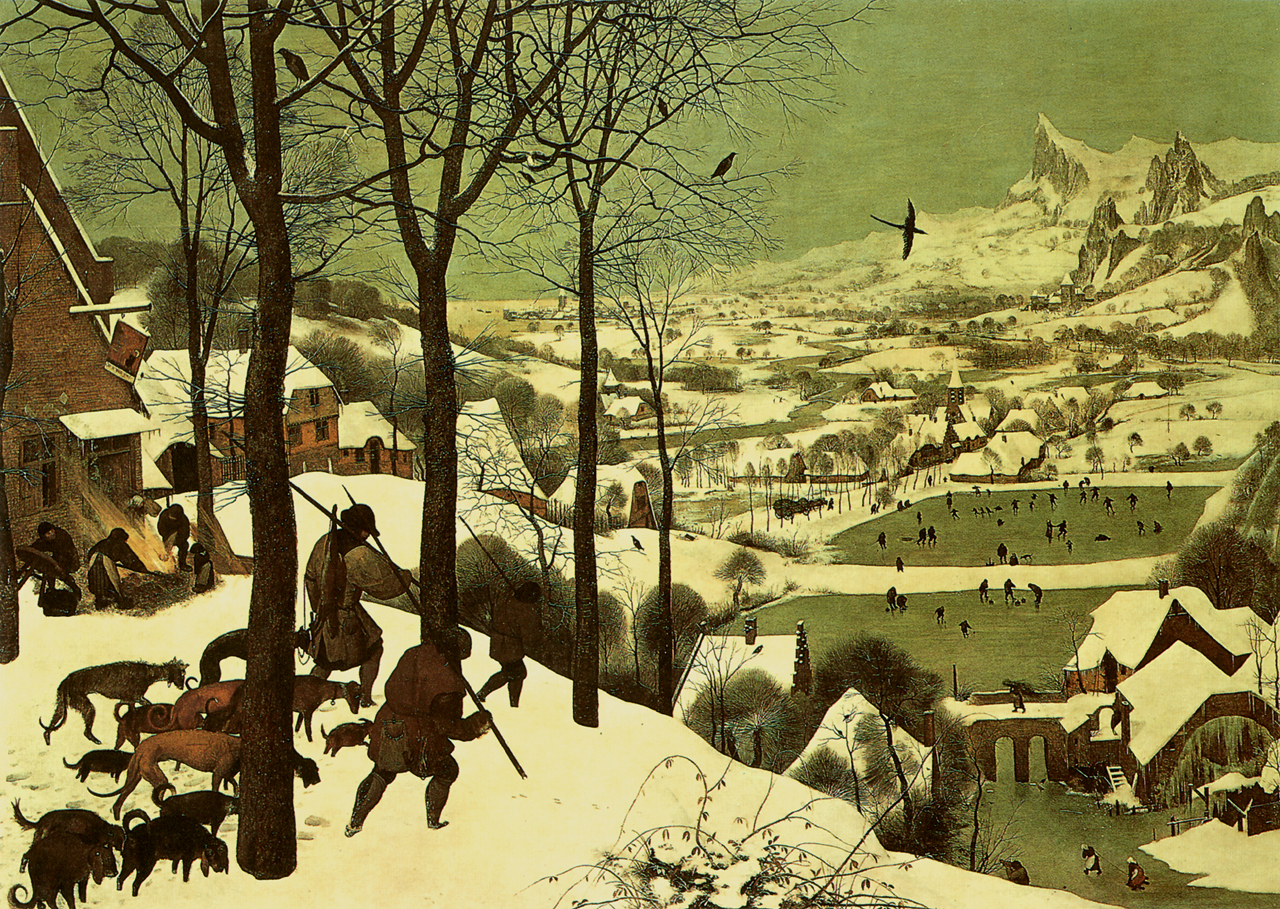
Hunters in the Snow


Have you seen Solaris? No, not the George Clooney version. I mean the 1972 Soviet classic directed by the great Andrei Tarkovsky. You remember the story; Kris Kelvin, the troubled-looking gent in the still shot above, is sent to a space station to investigate a mission that has gone all pear-shaped. The scientists on the mission are supposed to be researching a watery, ocean planet called Solaris. But, their research has produced strange findings. When Kelvin arrives on the ship, he discovers that things have indeed gone awry. The ship is a mess, one of the scientists has killed himself and mysterious, unidentified visitors are seen and heard flitting through the corridors.

With his colleagues are cagey about these details, Kelvin awakens to find that his dead wife, Hari (who we seat seated on his lap above) has re-appeared. Is she purely a product of his imagination? A delusion? She is seemingly impervious to destruction; when she is wounded, she heals rapidly. When she is ejected from the ship, she just returns the following night. Kelvin comes to understand that she is a non-human replication of Hari harvested from his memory by the churning waters of Solaris and materialized from neutrinos.

At the same time, this non-human Hari—a hybrid fusion of Kelvin's memory and the sentient ocean—begins to gain self-conscious. Initially, Hari is unable to remember the past; she can't identify herself in a framed photograph that Kelvin brings from Earth. Slowly, she differentiates herself from the terrestrial Hari, who persists only in Kelvin's memory and his photographs, and she takes on a life of her own.

A very interesting visualization of this sentience then unfolds as we see Hari gazing upon the painting above: Jan Bruegel's Hunters in the Snow now in the Kunsthistorisches Museum, Vienna. A hunting party and a pack of hounds have entered the picture plane from the left as they descend snowy hillside toward a village. The pair of small lakes in the valley below have frozen solid. Silhouettes of skating adults and children flit across their surfaces. Craggy peaks sprout from the hillside beyond the pooled lakes as a single, darkened bird descends across the leaden sky.

Now, since Tarkovsky cuts between a shot of Hari looking at this image and a sequence of close-ups of the picture itself, we can infer that these shots offer us her point of view. The camera tracks slowly across the picture-plane, panning in and focuses upon specific, seductive details. And, as it does so, the film cuts to a scene of Kelvin as a boy playing in the snow—a scene from a film that Kelvin had previously shown to Hari. What we seem to be seeing, in other words, is this non-Hari's evolving capacity to make associations between perceptual data and mnemonic information. She says as much to Kelvin who calls her out of her reverie when she confesses that she has been "lost in my thoughts." If made from his mnemonic storehouse by Solaris's intervention, this hybrid non-Hari is beginning to take on a life of her own, to think for herself. If the scientists have been trying to study Solaris as Solaris has been trying to study them, it tempting to think of Hari's own consolidating consciousness as that frozen membrane of ice that separates the skaters from the chilly depths beneath. I'll need to come back to this topic later.

Wednesday, April 20, 2011

Allen Ginsberg


So, Sanford Sanchez is not normally a big Allen Ginsberg fan, but this video of his "Father Death Blues" is pretty great. I love the way he turns the phrase "father death" around from a particular, biographical fact into a proper name, then spilling that title outward to a range of identities and conceptions of mortality. Okay! That's it.