Showing posts with label Books. Show all posts

Monday, November 12, 2012

"A Resemblance too Perfect"

Lost has Sanford Sanchez been to the world of blogging these past months. Lost, it must be said, beneath a brimming pile of academic nonsense—as much a pile, often it has seemed, as a pyre alight with flames that needed to be extinguished before they got too far out of control. With the final weeks of courses now virtually in hand, I find myself drawn back to you with the discovery of a wondrous gem.

Let me set the scene: last weekend, I was prepping for a PhD defense on eighteenth century French anatomical culture and I wanted to check my facts on anatomical instruction at the Académie royale de peinture et de sculpture. So, I went to the library where I consulted a copy of Paul Duro's The Academy and the Limits of Painting in Seventeenth Century France (New Haven: Yale, 1997). There, I found the notes depicted above leaved into the book—notes not only on academic practice but on the very practices of wax modeling that figured prominently in the very dissertation I had been reading! While the notes are slightly ... well, I'm sure they merit transcription and your consultation as follows:

"Relationship between wax & art theory, part of a greater epistemological shift --> naturalism --> secularism + scientific knowledge, reconstituting art as knowledge. Issues of resemblance. Perhaps it is not surprising that a material that has an uncanny ability to imitate reality would be used for religious purposes in a religious society & scientific (anatomical) purposes in a more secular society. Begins with with Charles Sorel, the satirical portraitists, & the assault on the masked man --> interesting because Sorel is a satirist. The question of what is naturalistic (<<au naturel>>): on the one hand the portrait is denigrated within the hierarchy of genres because it reproduces nature without invention --> a slave to nature. On the other hand, here the average portrait is equated with distortion and deception --> the portrait projects the wishful fantasy of its patron. It is the satiririst -- and Soerl's satirical universe is both wild & absurd -- that provides the true image <<au naturel>>. The paradox of the mask in satire --> with the presentation of explicit masks - exaggerated portraits & invented caricatures -- that the satirist seeks to strip off the 'masks' of unreflective hypocrisy and vanity. Negotiating the relationship between wax sculpture and art theory. A resemblance too perfect: wax sculpture & art theory."

I bet that was one sweet paper!

Friday, June 1, 2012

My Grandmother's House

My grandmother died about a month and a half ago. In this photograph, taken the day after she died, I see some of the abiding features of her long, rich life. Take the yellow plastic telephone perched at the back of the wicker chair's seat, for example; it is one the many strange toys—the rusting metal trucks, the hairless dolls—she kept around in the event that children came by. Children were hugely important in her life; she worked with and thought about children constantly. Mother of four children, she collaborated on the reform of religious education after she finished seminary in the 1940s. She wrote numerous articles and several books about children and their confrontations with the kinds of questions traditionally answered by religion including her most famous book, which was in print for nearly sixty years. Although (as Mrs. Sanchez has astutely observed) my grandmother was one of the least overtly maternal people you could ever imagine, she took marveled at children and their ways. Putting an eye-catching prop like this yellow plastic phone well within their reach was sure to generate delights for her.

But, notice too how the seat of the wicker chair has been strengthened by a square of plywood. Born in Irish south Boston in 1919 and then made a child of the Depression, my grandmother hated to see things wasted. And, on the surface at least—that is, as here, on the outward-facing porch of her house—she liked to show that frugality with an aesthetic of practically-minded functionalism. If you think this plywood patching job is crude, you should have seen the knotted messes she made of my (fashionably) holey sweaters, which she often offered to darn.

I stress the outward show of this frugality as her house itself held a remarkable array of treasures. The story goes that many of the artifacts and the bulk of the library had been amassed by my grandfather's great uncle in late nineteenth-century Philadelphia. His ne'er-do-well children squandered his fortune and what remained of his prodigious collection of books and Arts and Crafts-era work (William Morris was a particular favorite, as this totemic portrait will suggest) was brought north by my grandfather's two spinster aunts in the 1960s. Amazing things remained; a Gutenberg bible, an invitations to Dryden's funeral, a letter of introduction for Gandhi. In the 1980s, an insurance appraiser found a Rembrandt print in the attic.


But, only to a keen eye would the loot that loot be visible. Typically, visitors would enter from the porch—by-passing the weird dolls, phone and busted trucks—into the kitchen where my grandmother would inevitably be seated by the soap-stone wood stove in her rocking chair. You would be ordered right back out of the house and into the garage to retrieve an armload of wood had you been so foolish as to come unprepared.

Inevitably, this would lead to some banter about navigating the Scylla and Charybdis that barred the completion of such tasks. As she had slowed down in later years—intermittently hobbled by a bad hip and then persistent shingles—she increasingly insisted upon "saving steps!" Doing so required contorting the body into a ruthless, Taylorist fantasy of totally efficiency of movement. However, saving steps was not to be taken so far that the would-be helper ended up carrying a "lazy man's load." Contrary to common sense (at least as I saw it), a lazy man's load denoted carrying so much that the job could almost be done in a single trip ... but would invariably go pear-shaped and require picking items up off the floor once dropped. I loved to tease my grandmother with the apparently contradictory instructions she dealt out as we tried to name precisely where a given load of wood fell on the step-saving/lazy man's load continuum.

As you may have guessed, precision, accuracy, getting things right were hugely important to my grandmother. If the hundreds of commentaries she read on her local radio station exemplify that conviction of voice, then this grimy fingerprints on her well-turned copy of Louis Leslie's 20,000 Words indicate the hard work—the commitment to craft—through which that clarity was achieved. Invariably, the public radio station would be on when I came into the kitchen. After running the gauntlet of the wood, she would tell me to turn the radio off. I would sit opposite her by the fire and she would start in with her standard, inquisitorial practice. When would I finish my dissertation? Would I ever get a job? Was I going to get married? How about children?

When I was a child myself, we would occasionally be received into the adjoining room to the west, the "fern room" (so-called on account of the wallpaper). That table in the lower right hand corner of the photography and the rotary phone used to flank the northern wall of the room. I remember my grandfather sitting in that chair, drinking a whiskey at holiday gatherings. 


Holidays were the only occasions when we were allowed to go into the formal dining room on the south side of the house. Prior to my grandmother's death, I never really had the opportunity to look at the silverware in the room. As a kid I was always too busy hustling dishes in and out of the room, refilling the water pitcher or keeping myself alert to this cruel game called "pig" that was sometimes played during the meal.

I realize now that many of these games were played with the silverware, but in a scrupulous effort not to see it as such. One such game involved an initiator performing a wondrous act of fiat whereby the saltshaker became "the cat" and the pepper-shaker became "the dog." One newly-minted animal would be passed ceremonially around the table clockwise, while the other moved counterclockwise. With every transfer of fauna, the carrier was required to introduce the relayed artifact by saying either "this is the cat" or "this is the dog." All of this was straightforward until the trajectories of cat and dog overlapped; two nearly identical, silver objects would descend from opposite side with relatives simultaneously declaring them to be household animals. The trick was to receive them both and pass them on appropriately without confusing their stipulated values. On this day after my grandmother's death, I was happy to have a moment to contemplate the silverware in its silence. Obviously, these pitchers aren't cats or dogs at all; they're geese.

Just west of the dining room is a formal entryway lined with portraits of long-lost relatives. My grandmother affixed index cards in the corners of many, as in the mustachioed gent at upper right. I don't think she ever troubled herself with the question of who painted these pictures. Then again, they are hardly masterpieces. But, the richness of pattern visible here—the gilt edging of the lacquered chair, the competing Anatolian carpets at right foreground and left middle-ground, the floral print of the wallpaper—this all spoke to me of a sultry, aging hedonism concealed behind the white-washed Yankee frugality of the house's front.
Walking through the house on that April afternoon, I was struck too by the glorious light captured in those far western rooms ...
... and by the baffling, distant books my grandmother liked to read: The Bible of the World, The World of Washington Irving. (In her defense, I doubt she ever read The Negro Caravan, which is second from left!)

What else is there to say that is not already latent in these images of her house? My grandmother was a great lady and a strange bird.

Saturday, January 14, 2012

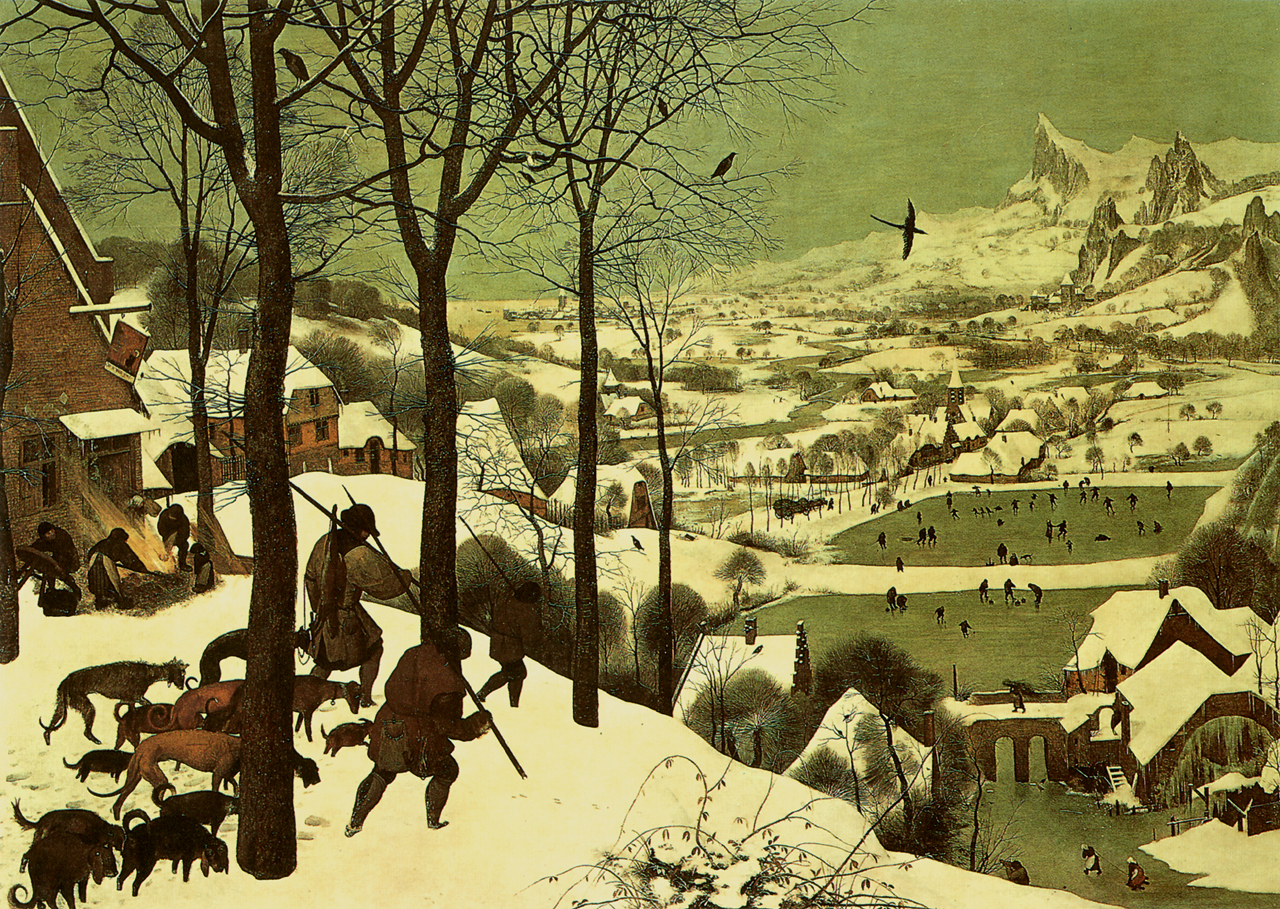
Hunters in the Snow


Have you seen Solaris? No, not the George Clooney version. I mean the 1972 Soviet classic directed by the great Andrei Tarkovsky. You remember the story; Kris Kelvin, the troubled-looking gent in the still shot above, is sent to a space station to investigate a mission that has gone all pear-shaped. The scientists on the mission are supposed to be researching a watery, ocean planet called Solaris. But, their research has produced strange findings. When Kelvin arrives on the ship, he discovers that things have indeed gone awry. The ship is a mess, one of the scientists has killed himself and mysterious, unidentified visitors are seen and heard flitting through the corridors.

With his colleagues are cagey about these details, Kelvin awakens to find that his dead wife, Hari (who we seat seated on his lap above) has re-appeared. Is she purely a product of his imagination? A delusion? She is seemingly impervious to destruction; when she is wounded, she heals rapidly. When she is ejected from the ship, she just returns the following night. Kelvin comes to understand that she is a non-human replication of Hari harvested from his memory by the churning waters of Solaris and materialized from neutrinos.

At the same time, this non-human Hari—a hybrid fusion of Kelvin's memory and the sentient ocean—begins to gain self-conscious. Initially, Hari is unable to remember the past; she can't identify herself in a framed photograph that Kelvin brings from Earth. Slowly, she differentiates herself from the terrestrial Hari, who persists only in Kelvin's memory and his photographs, and she takes on a life of her own.

A very interesting visualization of this sentience then unfolds as we see Hari gazing upon the painting above: Jan Bruegel's Hunters in the Snow now in the Kunsthistorisches Museum, Vienna. A hunting party and a pack of hounds have entered the picture plane from the left as they descend snowy hillside toward a village. The pair of small lakes in the valley below have frozen solid. Silhouettes of skating adults and children flit across their surfaces. Craggy peaks sprout from the hillside beyond the pooled lakes as a single, darkened bird descends across the leaden sky.

Now, since Tarkovsky cuts between a shot of Hari looking at this image and a sequence of close-ups of the picture itself, we can infer that these shots offer us her point of view. The camera tracks slowly across the picture-plane, panning in and focuses upon specific, seductive details. And, as it does so, the film cuts to a scene of Kelvin as a boy playing in the snow—a scene from a film that Kelvin had previously shown to Hari. What we seem to be seeing, in other words, is this non-Hari's evolving capacity to make associations between perceptual data and mnemonic information. She says as much to Kelvin who calls her out of her reverie when she confesses that she has been "lost in my thoughts." If made from his mnemonic storehouse by Solaris's intervention, this hybrid non-Hari is beginning to take on a life of her own, to think for herself. If the scientists have been trying to study Solaris as Solaris has been trying to study them, it tempting to think of Hari's own consolidating consciousness as that frozen membrane of ice that separates the skaters from the chilly depths beneath. I'll need to come back to this topic later.

Monday, January 2, 2012

Bad Language

Dear Blogging:

I have been reading Mr. Bligh's Bad Language: Passion, Power and Theatre on the Bounty (Cambridge UP, 1994) over the past week or so, and I thought you might want to learn some more about it. I remember how much you like boats, after all!

Now, you remember the story of the mutiny on the Bounty, right? It's an ugly one. At the bidding of Royal Society President, Joseph Banks, and other power-brokers, William Bligh is commissioned to travel to Tahiti, acquire a cargo of germinating breadfruits and then transport them back to Jamaica where they will serve as a cheap and sustainable source of calories for the slaves working on British sugar plantations. Sadness of sweetness and all that.

Bligh is keen to make a quick passage from Britain to Tahiti and so he tries to sail south and west around Cape Horn. After weeks of grueling effort, this project goes completely pear-shaped, so he sails east. But, because of this delay, the Bounty arrives at Tahiti past the breadfruit's germinating season. Fearing that his vegetable cargo will all die on the journey, Bligh keeps the boat anchored in Tahiti's Matavai Bay for  five months.

While this was good for the breadfruit, it was even better for the crew who had a lusty time mixing it up with the Tahitian ladies. However, once they are back under sail and subjected to the rigors of life at sea, so the familiar story goes, the crew quickly lost patience with Bligh. A cruel, tactless disciplinarian, Bligh and his liberal use of the lash prompted the famous mutiny by Fletcher Christian who exiled Bligh and those faithful to him to a small launch. Christian eventually takes the Bounty off to Pitcairn island where he meets his end.

By Greg Dening's celebrated revision, this standard history misses much of the story. Rather than being a cruel sadist, Dening shows how Bligh was actually one of the least violent naval leaders in the British Pacific of his time. A sub-chapter and extensive quantitative data in the notes go to make the point that Bligh only flogged a fraction of the 20% of sailors on British ships in the Pacific who received a taste of the whip for their troubles. So, if it wasn't an excess of discipline that prompted the mutiny, what was it? Part of Dening's argument is that Bligh and his ship confused the boundaries of legitimate authority as eighteenth century sailors would have recognized it. If never capacious, the distinguishing exclusivity of the captain's private quarters aboard the Bounty were seriously compromised once colonized by Banks's breadfruits. Further, by serving as both commander and "purser" (or entrepreneurial outfitter) of the Bounty, Bligh split his loyalties. And while he might appear more humane in punishing with wicked insults instead of whips, Bligh's eponymous "bad language," Dening claims, critically undermined his standing as the kind of Enlightenment gentleman to whom the crew would implicitly give its allegiance.

Some of the book (I'll confess to you, dear Blogging) reads as a bit old fashioned in that early nineties sort of way with lots of self-conscious reflection on the craft of the historian and the polysemic nature of texts, etc. Much—or at least the chapter on the death of Capt. Cook on Hawaii—reads as a large piece of debt to the work of Marshall Sahlins. And I haven't yet reached the end. But, a good read nonetheless.

Love -

Sanford Sanchez