Showing posts with label Photography. Show all posts

Wednesday, December 17, 2014

A Festival of Fried, Part III: One Foot in the Grave


Michael Fried gives us a vision of personified animals in his poem “Care,” which he dedicates to Allen Grossman, one of the leading interpreters of his poetic work. As in poems such as “The Hilltop” with its Aesop-like speaking fox, eagle and rabbit (NBR 58), “Care” imagines a badger who has amassed a collection of art but is concerned that it will be squandered or destroyed, implicitly after his death. While the image of the nervous keeper of a horde of treasure is interesting enough, the badger’s subterranean habit and its way of digging in the earth particularly caught my attention. For, the motif of digging is one that occurs frequently across Fried’s oeuvre. His poem “Cézanne” finds the narrator collapsing after “a day spent looking at paintings / I’m as exhausted / as I would be if I had dug a trench.” (NBR 12) If this equation of looking and trench-digging sounds a bit rich from someone who has probably never dug a trench in his life, Fried also then turns the equation around to imagine a reciprocal exhaustion on the part of the painter. The labor of making the painting figures as “a day spent digging trenches.” (NBR 12)

Understanding acts of looking at and making pictures qua digging also finds instructive resonance in Fried’s art historical writing. In “Painter into Painting” from 1982, Fried takes the bent bodies of Gustave Courbet’s Stonebreakers (at left), who painfully smash and heft bits of earth, as allegories of the hands of the artist painting the figures: “The old stonebreaker and his young counterpart may be seen as representing the painter-beholder’s right and left hands respectively: the one wielding a shafted implement that bears a distant analogy to a paintbrush or palette knife, the other supporting a roundish object that might be likened to the (admittedly much lighter) burden of a palette.” (PP, 641-2) Just as the poet’s labor of looking at paintings is equivalent to the trench-digging work of the artist who makes them, so both actions register in Courbet’s simultaneous identity as painter and first beholder of his own work (PP, 634). These actions then get transcribed—or better, personified—as markers of Courbet’s own identity (see PP, 642-3) as he fulfills what Fried sees as his ambition to “transpose himself as if corporeally into the painting on which he was working” (PP, 634) as a way to overcome the theatricality felt in his position in front of the canvas.

There is another way in which digging and “earth-work” figures significantly in Fried’s reading of Courbet, however. In an article from 1983, Fried approaches Burial at Ornans through Courbet’s landscapes of the late 1840s, teasing out the role of central, serpentine forms often occupied by images of rivers. These river motifs serve to guide the eye into and through the landscape, but their resulting hollows and declivities follow from a Kunstwollen directed at carving out a deeper kind of ground-work: “a desire for excavation and filling in, a desire that ... receives its most direct and in a sense its most capacious expression precisely in the Burial.” (SB, 654) What is driving this desire, Fried will argue, is Courbet’s aim to undermine his own separation from the painted worlds he is creating with the effect that “the bottom of the picture is subjected to extraordinary pressure in Courbet’s art.” (SB, 663) So, whereas the chiasmic labors of Cézanne and his viewer make for parallel but discrete trenches, Courbet’s split identity and simultaneous occupation with seeing and painting makes earthwork central to his project. Of the foregrounded grave in the Burial, Fried writes: “We might say that both the location and the treatment of the grave bear witness to a resolve to cut the ground out from under the feet of the beholder and by so doing to leave him nowhere to stand outside the Burial itself. Part of the tool by which that labor presumably was accomplished can be made out just to the left of the grave: the blade of a shovel, crusted with dirt and, like the grave, abbreviated by the bottom framing edge. This is suggestive ... much as if the fictive activity of excavating the grave (of excavating this grave precisely here) and the actual activity of painting the Burial were in crucial respects analogous.” (SB, 666)

All of these effects, we need to remember, follow from the central thrust of Courbet’s project: “the painter-beholder’s ‘fantasmatic’ insertion of himself into the painting” or, again, “the heavy urgency of the painter-beholder’s determination to achieve union with the painting before him.” (SB, 676) Given the ancient gendering of the cold, wet earth as feminine, Fried can hardly escape from the sexual address of this urgent drive for insertion through the bottom or “from the rear” (PP, 638); indeed, in his Courbet book, Fried will take on these questions directly. But, reading his poetry, what struck me particularly was Fried’s return to these metaphors of excavation and passage into the earth, as it were, in reverse. In a poem called “The Tunnel,” the narrator describes his father made fluid—dying “of a cirrhotic liver / caused by poisoned blood / flushed through him one winter dawn / to fight a bleeding ulcer” (NBR, 7)—penetrating a stony portal: “He found a stone wall / with, at its base, a tunnel / just too narrow to admit / a man. Undaunted he crawled though / hand over hand/ to the other side.” (NBR, 7) Unlike the hands-made-into-bodies as the artist passes into Stonebreakers and out of theatricality, the broken body of the leaking father passes out of life through a stone portal, a grave.

This brings us back to the worried badger. This badger, Fried tells us, has a poet-friend who collects ancient pots, keeping them in an apartment “like a cave.” (NBR, 13) As with the entombment of the father, these pots are “of hard gray stone.” (NBR, 14) Yet, where the father himself had become fluid, these subterranean, stony vessels remain available for activation by artistic penetration. The badger’s friend is convinced that one of these newly-acquired pots “was a scribe’s inkwell. / When the time comes he will dip his pen in it / to write his gravest / songs.” (NBR, 14) Moving with the venerable alignment between power and penetration noted in the reading from Leo Bersani (IRG, 21), death is turned into life by this act of insertion, the cave-like setting and the material grave recouped into immortal, poetic gravity. “Care”, then, is not only the condition of Dasein to the world, but the kind of comportment one needs for reading and writing around the grave. So we saw in class two weeks ago, one of the most ingenious features of Fried’s writing on Courbet is the plotting of the reader like the mourners in the burial as “walking slowly, almost somnambulistically, in the ultimate direction of the open grave.” (SB, 647) Like Stanley Fish’s account of Paradise Lost where the reader endlessly performs the plot by falling—by failing to identify with the right party, by being tricked into Satanic rhetoric—we who fail to see the poetic jaws enfolding around us (if we miss this reference to the plotting of appreciation for the depiction of acts carried out “automatically, as if unconscious ... [with] almost somnabulistic character” [AMTFP, 144]) will end up occupying the grave, rather than sprung artistic from it.

So much for where we left off last time. Soon after class, I received an email from a colleague who shared this insight: “I had a little epiphany this morning: graphein = to dig, to carve, to write.” An excellent point. The etymology of the graphic—binding writing, drawing and digging—would certainly have been known to Fried as, among others, Svetlana Alpers talks about it at some length in The Art of Describing (1983), which he cites in various places. But, it also raises an interesting question about Fried’s account of Courbet—one of particular relevance to our readings for today. That is, if Courbet is moving around his signature in Stonebreakers from right to left; if he is making his central figures in that painting into isomorphs of his own initials, and—most critically—if he is operating with this conception of painting as digging/excavating, might we not also see him as sharing Eakins’s conflict between writing/drawing vs. painting, between the quasi-Wölfflinian graphic versus pictorial seeing? In other words, where Fried sails imperviously between Courbet’s drawings and paintings but sees those relations as problematic in Eakins, might the graphic not be seen to menace Courbet as well?
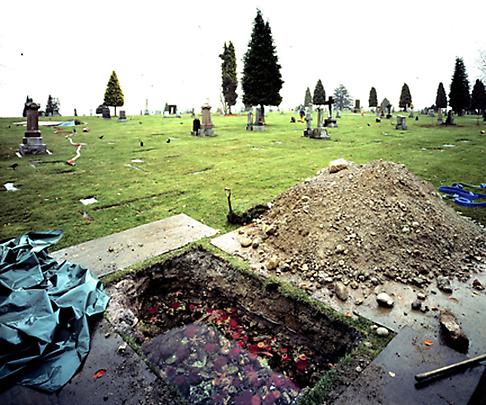
These questions are pertinent for us today as the figure of the excavation and the filling grave occur again in Fried’s writing on photography. Offering an extended account of photographer Jeff Wall’s laborious working process (based on their own, private email correspondence) as split between on-site shoots and digital reconstruction, Fried parenthetically observes that “as yet Wall has found no means of acknowledging in his art the prolonged and repetitive labor that goes into the making of a work like Morning Cleaning, though, perhaps the imagery of digging a well, a grave, or an anthropological site, as in The Well, The Flooded Grave [above], and Fieldwork may be viewed in that light.” (JWWE, 524) As presented here, Wall’s attention to sites of digging are privileged as they appear to answer to the modernist moral value of acknowledging the material conditions of their making without being reduced to them. Just as viewing and writing about pictures is like digging the graves that figure in Fried’s texts, shooting and digitally building photographs are like the earthy excavations Wall shows us.

But, might this gravitation toward the grave in Wall’s work not also help us to think about the morbidity of photography in recent discourse. Themes of death feature prominently in Roland Barthes’s Camera Lucida (see BP, 558-561), a work central to Fried, Michaels and many others. Yet, how do metaphors of vulnerability and loss of control figure more broadly in conversations about photography? More to the point, what is at stake in these figures?

Works Cited

NBR: Michael Fried, The Next Bend in the Road. Chicago: University of Chicago Press, 2004

PP: Michael Fried, “Painter into Painting: On Courbet’s After Dinner at Ornans and Stonebreakers,” Critical Inquiry 8, 4 (Summer, 1982): 619-649

SB: Michael Fried, “The Structure of Beholding in Courbet’s Burial at Ornans,” Critical Inquiry 9, 4 (Jun., 1983): 635-683

IRG: Bersani, Leo. "Is the Rectum a Grave?" October. 43 (1987): 197-222.

AMTFP: Michael Fried, “Absorption: a Master Theme in Eighteenth-Century French Painting and Criticism,” Eighteenth-century Studies 9, 2 (1975): 139-177

JWWE: Michael Fried, “Jeff Wall, Wittgenstein and the Everyday,” Critical Inquiry 33, 3 (Spring 2007): 495-526

BP: Michael Fried, “Barthes’s Punctum,” Critical Inquiry 31, 3 (Spring 2005): 539-574

Thursday, April 18, 2013

Milk and Blood: Re-reading Jeff Wall

At the beginning of his short (that is, four paragraph) essay "Photography and Liquid Intelligence" (1989), Canadian photographer Jeff Wall refers the reader to his photograph Milk (1984). Much is happening in Wall's strongly planar image. Like one of Richard Diebenkorn's Ocean Park pictures turned on its side, Milk parses into four vertical strips. As read right to left, subtle shades of brick tone interweave like feathers on a bird's wing in the largest panel, which terminates in the crisp zip of black cast by the ruddy, jutting abutment at center left. Cooler tones abound in the sap-green shrub and the cerulean blue of sky reflected in the glass that separates us from the strong descending diagonal of railing that traverses heavens down to earth.

Back on the ground—at "street level," below our point of view—a man crouches, his proper left knee gathered to his body by a flexed arm. Held at or just above his crotch is a carton of milk cloaked in a paper bag. From it issues a veil of white liquid as the titular milk spurts upwards to describe a half arc. But, what has caused this explosion? The grasping hand that holds the carton betrays less the violent squeeze seemingly required to create this spray nor does his static right arm indicate any recent sideways motion.

Directed instead by the punching gesture of the figure's left fore-arm, we might think of Harold Egerton's Bullet through an Apple (1964), in which the visual rupture is caused not by the agent holding the object yielding the white spray. Rather, that visual action has been produced by some force entering the picture plane in the direction of my ekphrasis above—that is, right to left.

None of this concerns Wall in his 1989 essay. Instead, he uses Milk to exemplify an interface of the natural and the mechanical that he takes to have a particular salience in photography. "I think this is because," Wall explains, "the mechanical character of the action of opening and closing the shutter - the substratum of instantaneity which persists in all photography - is a logical relation, a relation of necessity, between the phenomenon of the movement of a liquid, and the means of representation." (Wall, 90)

As the stasis of Milk's tectonic planes are activated visually by liquid eruption, so photography in Wall's mythic telling becomes animated by this opposition of the dry and the wet. If the waters used in the traditional, chemical developing tray bears "a memory-trace of very ancient production processes - of washing, bleaching, dissolving, and so on," they are sharply differentiated from the dry realms of lenses and mechanics. Here is Wall's compelling statement of this point, and its implication: "This part of the photographic system is more usually identified with the specific technological intelligence of image-making, with the projectile or ballistic nature of vision when it is augmented and intensified by glass (lenses) and machinery (calibrators and shutters). This kind of modern vision has been separated to a great extent from the sense of immersion in the incalculable which I associate with 'liquid intelligence.'" (Wall, 90-93)

Wall's choice of Milk, thus, begins to take on an additional valence. Like that fluid prompted by mammalian gestation and rupturing here from its commodified encapsulation, photography itself is generated by the meeting of cold, wet, incalculable intelligence and dry rationality. However nuanced Wall's reading of gender may otherwise be, ancient, humoral elements - cold, wet feminine matter being organized by hot, dry masculine form - are being mobilized here to model photography in Milk's lactative image. If milk is made after sexual reproduction, so Milk—instance of and metonym for photography—follows the conjunction of the dry and the wet, the projectile and the immersive, the rational and the incalculable that structure Wall's broader conception of the medium.


Whether or not this is a heteronormative myth Wall is spinning, a different question quickly surfaces if we trace possible roots for his conception of photography's liquid and dry intelligences. One possible source is the work of British-born psychologist Raymond Cattell (1905-1998). Little known in art history, Cattell was both highly influential and massively productive. "The author of fifty-six books, more than five hundred journal articles and book chapters, and some thirty standardized instruments for assessing personality and intelligence in a professional career that spanned two-thirds of a century," so one recent interpreter has put it, "... Cattell must be considered one of the most influential research psychologists ever." (Tucker, 1)

Among numerous accomplishments, contributions and accolades, Cattell articulated a crucial cleavage within human aptitude, bifurcating the study of general intelligence (or g in the technical parlance) into what he called "fluid" and "crystallized" intelligence (or gf and gc, respectively). Here is Cattell's description of these discrete native versus learned aptitudes from 1964: "Crystallized ability loads more highly those cognitive performances in which skilled judgment habits have become crystallized (hence its name) as the result of earlier learning application of some prior, more fundamental general ability to these fields. ... Fluid general ability, on the other hand, shows more in tests requiring adaptation to new situations, where crystallized skills are of no particular advantage." (Cattell 1964, 2-3) Expressed most clearly in situations requiring improvisation, fluid intelligence was importantly informed by biology if not exclusively reducible to it. He puts it this way:

For any same-age group the nature-nurture variance ratio will be much higher for gf than gc on the hypothesis that gf is directly physiologically determined whereas gc is a product of environmentally varying, experientially determined investments of gc. ... However, although it is our hypothesis that gf is biologically and physiologically determined, as a function of total cortical cell count, this does not mean that one would expect anything like complete hereditary determination. For environment includes gestation period influences and later physical trauma and physiological change, all 
affecting gf. (Cattell 1964, 3-4)

One might indeed expect this attention to multifarious factors informing intelligence as Cattell himself significantly advanced and repeatedly championed multi-variant factor analysis in the study of human personality. No fan of Cattell's work, intellectual biographer William H. Tucker nonetheless acknowledge this as a lasting, influential insight. "The distinction between fluid and crystallized intelligence," Tucker writes, "is recognized as a landmark contribution, cited not only in every book on intelligence but also in numerous introductory psychology books. ... The separation of fluid and crystallized intelligence has been one of Cattell's most enduring substantive contributions of psychology." (Tucker, 53-4)

However, heredity plays an interestingly forceful role in Cattell's thinking about intelligence. Not only is the fluid more nimble than the crystallized intelligence in his scheme, but that the former is also enduringly constitutive of an individual's ability. Where fluid intelligence abides, crystallized, book learning decays and is itself, as it were, already dead. Cattell had turned to an instructive turn of phrase drawn from watery depths to make that point in an earlier publication: "If the crystallized abilities are, as it were, a dead coral formation revealing by its outlines the limits of growth of the original living tissue, the crystallized abilities will approximately the same intercorrelations as the original fluid abilities." (Cattell 1943, 178-9) Thus, in correlating the tabulated data of gf and gc, Cattell declines the possibility that these two modes of intelligence combine some new form. Instead, he argues, they need to be read through "a single influence, which is fluid ability as it stood during the formative period of crystallized ability, [that] is causative to the present levels of both." (Cattell 1964, 15) Living, physiologically determined, and significantly biologically heritable, fluid intelligence describes a threshold of possibility that can be analyzed in the decaying crystallized artifacts of which it is itself the cause.

We might note here that Raymond Cattell was a committed eugenicist. As historian William H. Tucker argues, Cattell shared with mentors Charles Spearman, Cyril Burt, and William McDougall "the belief in the power of heredity as an article of faith necessary for justification of the eugenic agenda, more than as a scientifically demonstrable result. In 1938, discussing the deleterious social effects that would be caused by the disproportionate reproduction of the less intelligent, Cattell declared it an accepted fact that 'mental capacity is largely inborn.'" (Tucker, 67) So, even if as he would put it in 1964 that "does not mean ... complete hereditary determination," the fluid intelligence that animates -- that makes possible the conditions for the crystallized intelligence derived from it -- is still significantly biological and inheritable through sexual reproduction. It flows through the blood.

Is blood to Cattell's fluid intelligence, then, what milk is to Wall's liquid intelligence? In both schemes, wet intellect is valorized. For Cattell, it underpins, enables and outstrips crystallized abilities in its improvisatory fluency. For Wall, it is the "concrete opposite" of photo's dry rationality that menaces, undermines and extends far beyond optics and mechanics. In both schemes too, animating intelligence is contingent upon the mating of sexualized components. This is literally true for Cattell, since part of the eugenicist aim of his project was control reproductive rates of the less intelligent thus increasing the net threshold of genetically-heritable material (and hence, fluid intelligence) in the population at large. As argued above, though, Wall's move is more metaphorical, positioning photography's particular cleverness at conjunction of wet, immersive liquids and dry, projectile tools. Photography is "perfectly adapted" (Wall, 90)—it is, like Cattell's more evolved humans, more highly sentient—insofar as it is generated from this fertile meeting of different intelligences of which milk, as lactating spray, is effect or, as seminal ejaculation, is complementary cause.


In the concluding paragraphs of the 1989 essay, Wall indicates that he means this in more than a metaphorical sense, I think. He calls our attention to Andrei Tarkovsky's classic cinematic work, Solaris (1972). In the film, Wall puts it, "some scientists are studying an oceanic planet. Their techniques are typically scientific. But the ocean is itself an intelligence which is studying them in turn." (Wall, 93) Indeed, what we see in the still above is one of those scientists, Kris Kelvin, holding on his lap a simulacrum of his dead wife, Hari, who has mysteriously re-appeared on board the space ship. This Hari is not purely a product of his imagination as some Athena burst forth from the forehead of Zeus. But, nor is she exclusively a delusion foisted upon Kelvin by the liquid intelligence of the churning ocean planet far below. Instead, she is a hybrid fusion of Kelvin's intellect and the sentient ocean who begins to gain self-conscious, to take on a life of her own.

It is precisely this feature of autonomous life born from the mating of "concrete opposites" that Wall targets as salient model for photography. Here's how he concludes his essay:

It [the planet Solaris] experiments on the experimenters by returning their own memories to them in the form of hallucinations, perfect in every detail, in which people from their pasts appear in the present and must be related to once again, maybe in a new way. I think this was a very precise metaphor for, among many other things, the interrelation between liquid intelligence and optical intelligence in photography, or in technology as a whole. In photography, the liquids study us, even from a great distance. (Wall, 93)

Is Jeff Wall's thinking somehow infected with the eugenicist baggage of Raymond Cattell? Has Wall even heard of Cattell and his distinction between fluid and crystallized intelligence? I would resist insisting on either of these claims. What is more compelling, I think, is attending to ways in which Wall's imagining of photography's vitality—its capacity for higher, autonomous thought—is sprung from a matrix of sexualized union that was itself the site of Cattell's crucial, genetic transfer and abiding concern. As blood is to milk, so Cattell and his compatriots set parameters (unconscious though they may be) from which Wall's liquid intelligence cannot escape.

References:

Cattell, Raymond B. "The Measurement of Adult Intelligence." Psychological Bulletin 40, 3 (March 1943): 153-193.

________________. "Theory of Fluid and Crystallized Intelligence: A Critical Experiment." Journal of Educational Psychology 54, 1 (1964): 1-22.

Tucker, William H. The Cattell Controversy: Race, Science, and Ideology. University of Illinois Press, 2009.

Wall, Jeff. "Photography and Liquid Intelligence."


Wednesday, August 29, 2012

Re-Reading Walter Benjamin on Photography

Confession time: it has been a while since I last encountered them, but I found it totally delightful to re-read "The Work of Art in the Age of Mechanical Reproduction (from Illuminations) and "A Short History of Photography" (from Classic Essays on Photography, ed. A. Trachtenberg, p. 199-216). I had forgotten how interconnected—and overlapping—these essays are; yet, each has its own curious aperçues and discontinuities.

After several readings in past weeks (esp. Barthes and Bazin) that make no meaningful engagement with the technical processes of photographic image-making, Benjamin's attention to more of the nitty gritty was very welcome. Consider his notes in "Short History" on the interplay between posing and exposing in the 1850s. "The procedure itself," he writes, "caused the models to live, not out of the instant but into it; during the long exposure they grew, as it were, into the image." (204) Poses and photos alike were "set up to last"—forged in the 1850s to endure long exposures and then to last thereafter. Hence, Benjamin claims, the props and supports found in these pictures (the stools, columns, and so on) are not only the iconographic markers of stability as they had been through the portrait tradition descending from Van Dyck, but they were also functional objects that register the conditions of the protracted making of the pictures themselves. (205-6) Equally interesting is his note early on regarding the fact that Daguerre's photos may have been mechanical, but they were hardly reproducible: "They were unique and they cost, on average, 25 gold francs per plate." (201)

These notes are interesting as they remind us how Benjamin knew full well that photography was not a monolithic entity that eradicated aura from art via its reproductive function from the get-go. Indeed, as he observes in "Short History," early photographers themselves created a kind of aura, casting the sitter into a shadowy world of darkness and mystery. (207-9) Thus, the function for photography diagnosed in "The Work of Art" needs to be seen as a historically-evolved one. That withering of the auratic, cultic dimensions of the art-object achieved only once Atget and others had come to practice photography as a tool of demystification—so they could "suck the aura from reality like water from a sinking ship." (209) (Further comparison could be made as well between the highly dialectical presentation of interaction between photography and other hand-made pictorial productions in "Short History" versus the far more oppositional conception of photo and painting in "Work of Art").

But, in what sense is photography meaningfully understood as "reproductive"? And exactly what is at stake for Benjamin in conceiving it in those terms? In "Short History," he claims things like this: "While it is possible to given an account of how people walk ... we know nothing definite of the positions involved in the fraction of a second when the step is taken. Photography, however, with its time lapses, enlargements, etc. makes such knowledge possible." (202-3) Following on from Josh Ellenbogen's piece, we might well say that, in such cases, the photographs enabling these insights are productive—not re-productive at all. "Because Marey's devices charted displacements that humans had never observed on their own," Ellenbogen argues, "the data his devices produced were simply free standing relative to observation by human scientists, not better or more objective substitutes for it. Marey's data exist beyond human sensibility and so 'cannot be characterized as especially accurate visualizations of what might otherwise have been registered by an illustrator or scientist.'" (Ellenbogen, 91)

So, why shouldn't we say that photography doesn't make new objects of inquiry rather than reproducing familiar ones, albeit in new ways? I think this is where Benjamin's class story comes in. First, he wants to claim that embrace of reality even through reproductions is a defining factor of working classes in the industrialized world who, of course, have been defined historically through relations to the factory and the machine. "The desire of contemporary masses to bring things 'closer' spatially and humanly ... is just as ardent as their bent toward overcoming the uniqueness of every reality by accepting its reproduction. Every day the urge grows stronger to get hold of an object at very close range by way of its likeness, its reproduction." Further, historically forged through their interface with the machine, the masses also gain critical self-consciousness through the reproductive media by which they encounter reality. Since the film actor can't adjust to the whims of an audience before him, Benjamin claims: "This permits the audience to take the position of a critic, without experiencing any personal contact with the actor. The audience's identification with the actor is really an identification with the camera. Consequently the audience takes the position of the camera; its approach is that of testing. This is not the approach to which cult values may be exposed." Reading, say, Marey's images as reproductive—rather than as productive creations of new domains of scientific inquiry and expertise—thus enables a story whereby industrial workers laboring in factories producing mechanical replications come to forge class-consciousness through identifying with the mechanical medium by which they view the world and to adopt that medium's iconoclastic criticality.

Monday, August 13, 2012

Chance? Skill?


Robin Kelsey’s account of “historical action photography” is the visual practice most extensively reliant on accidents, luck, or chance. Indeed, this is the point as Kelsey’s argument holds that neither modernist nor postmodern views of photography have been willing to allot any space to chance: “Chance is the ontological vacuum and historical orphan around which the more favored subjects (institutional, discursive, individual) of writing on photography have for decades swirled.” (Kelsey, 60) The modernist point of view is basically a straw man in this narrative. Examining the case of the famous image of Marines raising the American flag on Iwo Jima, Kelsey stresses how—contrary to the “thin-slicing” of perceptual data by which the modernist photographer a la Henri Cartier-Bresson was able to intentionally grasp a crucial historical moment in a decisive photograph (Kelsey, 70-1)—photographer Joe Rosenthal not only restaged his shot (the flag-raising he shot was actually to replace another, smaller flag), but he actually imagined that another photo in his batch had won such acclaim. (Kelsey, 63; 65-6) Even if we shift the credit from photographer to editor in locating intentionality, the whole business begins to look pretty fishy: “When a photographer wheels around and with a click takes a picture that he or she has never envisioned, and then sense the film off for processing, editorial selection, and cropping, the relationship between the resulting photograph is more arbitrary and parasitic [than, say, with Jeff Wall or Walker Evans].” (Kelsey, 68) While he is willing to allow that great photographers higher probability of producing good shots than amateurs who just get lucky, Kelsey contends that this probabilism “does nothing to ease doubts about the meaning of any individual image.” (Kelsey, 74) And, by Kelsey’s reckoning it is this kind of fine-grained explication of images in institutional and discursive terms that has simultaneously marginalized chance from postmodern photography discourse: “The moderns have downplayed chance because it threatens the heroic intentionality and momentary revelation of the action photograph. The postmoderns have downplayed it to emphasize the institutions and discourses that manage all contingencies of meaning with scrupulous efficiency.” (Kelsey, 76) Although I am not sure that this account is being fair to either camp, the argument is that chance needs to be seen as a central, pervasive force when dealing with photography: “The camera, as an automatic picture machine, substituted the action of light for human labor, opening up new possibilities for chance.” (Kelsey, 75)

Second most chance-based by my reading is James Nothcote’s vision of Reynolds’s painting technique. Opening with a discussion of Nathaniel Hone’s The Conjuror of 1775, Northcote goes on to note how, despite Reynolds’s roles as President of the Royal Academy and the leading portraitist of his generation, he claimed that “there was not a man then on earth who had the least notion of colouring.” (Northcote, 17) To remedy the ignorance of the age, Reynolds was in possession of a theory. Northcote tells us: “It was Sir Joshua’s opinion, that if the vegetable colours (which are infinitely the most beautiful) were enclosed by varnish from the external atmosphere, they would not fade.” (Northcote, 20) However, not only was Reynolds wrong in point of fact as his notoriously fugitive paintings show (p. 18-19), but he became the docile subject of his advisors and his business. Northcote puts it this way: “In his own practice, … he would venture on whatever experiment was recommended to him by any advisor that came his way; and when he was at any time accused of having spoiled his portraits, by trying experiments upon them, he answered that it was always his wish to have made these experiments on his fancy pictures … but that he was prevented from practising thus, by his being at the time perpetually employed in painting portraits; and therefore obliged to make his trials on those, as eagerness in the pursuit of excellence was, in him, uncontrollable.” (Northcote, 21) So, despite his training and knowledge, Reynolds was unable to control his pigments or himself—deficiencies made particularly dangerous by the dubious adulterations practiced in London’s commodified color trade. (Northcote, 22) Also intriguing is the fact that Northcote closes out his account with an array of “accident” stories (p. 24-28)—of the fallings and befallings in the studio, including one tale in which Reynolds instructs him to achieve the best posture for depicting drapery not by elaborate posing, but “by taking the chance of another toss of the drapery stuff, and by that means I should get nature, which is always superior to art.” (Northcote, 28)

Chance and accident figure significantly in Reynolds’s reading Gainsborough. Not only did Gainsborough not enjoy the stabilizing, ennobling guidance of a trip to Italy, but his manner of working was significantly beholden to what he happened to come across in his daily life: “He had a habit of continually remarking to those who happened to be about him, whatever peculiarity of countenance, whatever accidental combination of figures, or happy effects of light and shadow, occurred in prospects, in the sky, in walking the streets, or in company. If, in his walks, he found a character that he liked, … he ordered him to his house: and from the fields he brought into his painting-room, stumps of trees, weeds, and animals of various kinds; and designed them, not from memory, but immediately from the objects. He even framed a kind of model of landskips, on his table, composed of broken stones, dried herbs, and pieces of looking glass, which he magnified and improved into rocks, trees, and water.” (Reynolds, 250) Not only is the artist beholden to what nature happens to throw before him, but those accidental specimens were treated by Gainsborough outside of classicizing imitation; they were merely copied. Yet, like Cozens’s attitude toward the blots—and perhaps even as with Duchamp’s view to his readymades in De Duve’s reading—Gainsborough’s “models thus accidentally found” were treated with their own kind of judgment and choosing informed by an extensive knowledge of the Dutch/Flemish schools. (Reynolds, 253) Thus, what appears to be accident and chance in Gainsorough’s finished paintings is judiciously seen as altogether different: “All those odd scratches [end 257] and marks, which, on a close examination, are so observable in Gainsborough’s pictures, and even to experienced painters appear rather the effect of accident than design; this chaos, this uncouth and shapeless appearance, by a kind of magick, at a certain distance assumes form, and all the parts seem to drop into their proper places; so that we can hardly refuse acknowledging the full effect of diligence, under the appearance of chance and hasty negligence.” (Reynolds, 258) So, although it does indeed have skill/artistic order within it, Gainsborough’s products—like his process—appears to be swamped by chance.

Since it uses accident and chance to achieve “dry”, rational results, I would put Alexander Cozens’s method slightly more to the skill end of the spectrum than Reynolds’s Gainsborough. The technique came to him, Cozens tells us, while working with a gifted pupil whose drawing he wanted to give more vigor: “At this instance happening to have a piece of soiled paper under my hand, and casting my eyes on it slightly, I sketched something like a landscape on it, with a pencil in order to catch some hint which might be improved into a rule. The stains, though extremely faint, appeared upon revisal to have influenced me, insensibly, in expressing the general appearance of a landscape.” (Cozens, 167-8) So, depiction of nature gives rise to an artistic idea that is, in turn, influenced by the inferior materials that happen to be to hand, which inspires the method. And that method is to begin with rough forms called “blots” (“an artificial blot is a production of chance, with a small degree of design” [Cozens, 169]), that are made to suggest landscapes; then, unctuous, transparent paper is set over the initial blot-page and a drawing is made by choosing key features in a project of graphic rationalization. That is, “the spirit of the blot as much as possible, by taking care not to add anything that is not suggested by it, and to leave out whatever appears to be unnatural.” (Cozens, 181) So, the artist had a key role in filtering and processing the chance-like forms; but, they also exert their capacity for suggestion back though the finished drawing.

By de Voogd’s reading, the marbleized paper printed in Sterne’s Tristram Shandy acts as “emblem” of the novel. That is, like the blotchy, stained paper produced from “a specially prepared liquid ground, [on which] blobs of paint were dropped, allowed to expand, and then drawn into a pattern by means of a comb” (de Voogd, 284), the novel appears to be artless, chaotic and ridden with accidents. This is just a clever ruse: “That novel, like the marbled page, is seemingly haphazard, the child of contingency, accidental, utterly dependent on the whims of chance and circumstance. Seemingly, because the expert marble can, and will, to a very great extent determine beforehand the outcomes of his design. Similarly, Sterne’s amazing novel is, appearances notwithstanding, tightly constructed.” (de Voogd, 285) So, there are some contingencies—exactly what form the marbling would take was left with the artisan, how the marbling would be affixed into the book was left to the bookbinder, and how the novel was read relied on the reader; but, overall, this is a feint of chance covering ingenious authorial skill.

Reynolds’s Discourse VI is extremely interesting as a meditation on relations between chance and skill. On the hand, the text opens as a direct rebuke to theories of genius, to those who would make art inexplicable and thus ultimately reliant upon some lucky gift from the gods. Reynolds, the hard-working painter and intellectual, has no time for this talk: “It is very natural for those who are unacquainted with the cause of any thing extraordinary, to be astonished at the effect, and to consider it as a kind of magick.” (Reynolds, 94) Consequently, it follows for Reynolds that, if they can’t be understood by the common herd, there are indeed rules for genius and, ultimately, that art is a knowable matter of science, of causes and effects—not of random, geistlich contingencies: “It cannot be by chance, that excellencies are produced with any constancy or any certainty, for this is not the nature of chance; but the rule by which men of extraordinary parts … work.” (Reynolds, 97-8) Now, if this all sounds very skill-oriented, lots of interesting liquid-talk begins to enter the conversation here with very curious consequences. First, Reynolds tells us that “Nature is, and must be the fountain which alone is inexhaustible; and from which all excellencies must originally flow.” (Reynolds, 101) Further, the path of true art is not obvious; its principles “do not swim on the superficies.” (Reynolds, 101) So, an eclectic path, drawing from a range of schools and artistic traditions is the best way forward. While navigating these water-ways of the modern schools, the artist should always “trace back art to its fountain-head; to that source from whence they drew their principal excellencies, the monuments of pure antiquity.” (Reynolds, 106) And, here is where we get the fabulous paradox about the roles of accident in the forming of artistic invention from imitation of past masters. On the one hand, the artist performs some (Duchampian?) choosing, alchemically converting dross into art: “He will pick up from dunghills what by a nice chymistry, passing through his own mind, shall be converted into pure gold.” (Reynolds, 107) Art-making is intentional choosing and skillful, alchemical transformation. Yet, to conceptualize how it is that new inventions can be made from old works, Reynolds’s appeals to a liquidy, alchemical accident in the forming of Corinthian bronze at the burning of Corinth—a chance event that no one intended. So, as much as this essay is aiming to rescue art as cause and effect from talk of luck and genius, that business is nonetheless tucked into the alchemical trope he deploys in this crucial passage.

To my reading, the de Marchi/Van Miegroet article was the most committed to a vision of artistic practice organized around skill—even if it does so while flirting with risk, accident and contingency. The story that the authors tell is, in a certain sense, a performance of their argument as they link together two agents, Joshua Reynolds and Adam Smith, who have lots of superficial, historicist connections in Enlightenment Britain, but seemingly little in common beyond that. Sharing a similar conceptions of market conditions and the circumstances that could drive prices, what ultimately bound Reynolds and Smith together was a conception of ingenuity or “intuiting ways to link causes and effects that seem remote from one another. The appearance of remoteness means that there are no obvious connections. The ingenious inventor, then, is one who forges those connections via many small links whose eventual chainlike character strikes the outside observer as ‘strange and wonderful’—precisely because it is more or less unexpected.” (de Marchi/Van Miegroet, 383) So, as with Gainsborough’s optical “magick” by which Reynolds himself is taken in, the pleasure of the ingenuity is in inverse proportion between means and ends—of the distance between parsimonious means and spectacular ends. (385) And setting out Smith’s theory of pricing—whereby manipulation of supply, vanity/fancy of consumers and market-share drive up prices, while also allowing the maker to cut labor-time—the authors argue that Reynolds’s unstable, experimental pictures were highly rational enterprises. (393-398) Far from being detrimental to his business, building some calculated obsolescence into the works was a shrewd calculation: “Even if only 10 or 20 percent of Reynolds’s pictures cracked badly, lost paint, or faded, … would be buyers were necessarily entering into a wager when purchasing a picture from him.” (401) What appears to be chance or accident in Reynolds’s facture thus needs to be seen as resolution born from a cold, rational examination of the conditions of artistic production and the formulation of a practice best calculated to succeed in that environment.

Friday, June 1, 2012

My Grandmother's House

My grandmother died about a month and a half ago. In this photograph, taken the day after she died, I see some of the abiding features of her long, rich life. Take the yellow plastic telephone perched at the back of the wicker chair's seat, for example; it is one the many strange toys—the rusting metal trucks, the hairless dolls—she kept around in the event that children came by. Children were hugely important in her life; she worked with and thought about children constantly. Mother of four children, she collaborated on the reform of religious education after she finished seminary in the 1940s. She wrote numerous articles and several books about children and their confrontations with the kinds of questions traditionally answered by religion including her most famous book, which was in print for nearly sixty years. Although (as Mrs. Sanchez has astutely observed) my grandmother was one of the least overtly maternal people you could ever imagine, she took marveled at children and their ways. Putting an eye-catching prop like this yellow plastic phone well within their reach was sure to generate delights for her.

But, notice too how the seat of the wicker chair has been strengthened by a square of plywood. Born in Irish south Boston in 1919 and then made a child of the Depression, my grandmother hated to see things wasted. And, on the surface at least—that is, as here, on the outward-facing porch of her house—she liked to show that frugality with an aesthetic of practically-minded functionalism. If you think this plywood patching job is crude, you should have seen the knotted messes she made of my (fashionably) holey sweaters, which she often offered to darn.

I stress the outward show of this frugality as her house itself held a remarkable array of treasures. The story goes that many of the artifacts and the bulk of the library had been amassed by my grandfather's great uncle in late nineteenth-century Philadelphia. His ne'er-do-well children squandered his fortune and what remained of his prodigious collection of books and Arts and Crafts-era work (William Morris was a particular favorite, as this totemic portrait will suggest) was brought north by my grandfather's two spinster aunts in the 1960s. Amazing things remained; a Gutenberg bible, an invitations to Dryden's funeral, a letter of introduction for Gandhi. In the 1980s, an insurance appraiser found a Rembrandt print in the attic.


But, only to a keen eye would the loot that loot be visible. Typically, visitors would enter from the porch—by-passing the weird dolls, phone and busted trucks—into the kitchen where my grandmother would inevitably be seated by the soap-stone wood stove in her rocking chair. You would be ordered right back out of the house and into the garage to retrieve an armload of wood had you been so foolish as to come unprepared.

Inevitably, this would lead to some banter about navigating the Scylla and Charybdis that barred the completion of such tasks. As she had slowed down in later years—intermittently hobbled by a bad hip and then persistent shingles—she increasingly insisted upon "saving steps!" Doing so required contorting the body into a ruthless, Taylorist fantasy of totally efficiency of movement. However, saving steps was not to be taken so far that the would-be helper ended up carrying a "lazy man's load." Contrary to common sense (at least as I saw it), a lazy man's load denoted carrying so much that the job could almost be done in a single trip ... but would invariably go pear-shaped and require picking items up off the floor once dropped. I loved to tease my grandmother with the apparently contradictory instructions she dealt out as we tried to name precisely where a given load of wood fell on the step-saving/lazy man's load continuum.

As you may have guessed, precision, accuracy, getting things right were hugely important to my grandmother. If the hundreds of commentaries she read on her local radio station exemplify that conviction of voice, then this grimy fingerprints on her well-turned copy of Louis Leslie's 20,000 Words indicate the hard work—the commitment to craft—through which that clarity was achieved. Invariably, the public radio station would be on when I came into the kitchen. After running the gauntlet of the wood, she would tell me to turn the radio off. I would sit opposite her by the fire and she would start in with her standard, inquisitorial practice. When would I finish my dissertation? Would I ever get a job? Was I going to get married? How about children?

When I was a child myself, we would occasionally be received into the adjoining room to the west, the "fern room" (so-called on account of the wallpaper). That table in the lower right hand corner of the photography and the rotary phone used to flank the northern wall of the room. I remember my grandfather sitting in that chair, drinking a whiskey at holiday gatherings. 


Holidays were the only occasions when we were allowed to go into the formal dining room on the south side of the house. Prior to my grandmother's death, I never really had the opportunity to look at the silverware in the room. As a kid I was always too busy hustling dishes in and out of the room, refilling the water pitcher or keeping myself alert to this cruel game called "pig" that was sometimes played during the meal.

I realize now that many of these games were played with the silverware, but in a scrupulous effort not to see it as such. One such game involved an initiator performing a wondrous act of fiat whereby the saltshaker became "the cat" and the pepper-shaker became "the dog." One newly-minted animal would be passed ceremonially around the table clockwise, while the other moved counterclockwise. With every transfer of fauna, the carrier was required to introduce the relayed artifact by saying either "this is the cat" or "this is the dog." All of this was straightforward until the trajectories of cat and dog overlapped; two nearly identical, silver objects would descend from opposite side with relatives simultaneously declaring them to be household animals. The trick was to receive them both and pass them on appropriately without confusing their stipulated values. On this day after my grandmother's death, I was happy to have a moment to contemplate the silverware in its silence. Obviously, these pitchers aren't cats or dogs at all; they're geese.

Just west of the dining room is a formal entryway lined with portraits of long-lost relatives. My grandmother affixed index cards in the corners of many, as in the mustachioed gent at upper right. I don't think she ever troubled herself with the question of who painted these pictures. Then again, they are hardly masterpieces. But, the richness of pattern visible here—the gilt edging of the lacquered chair, the competing Anatolian carpets at right foreground and left middle-ground, the floral print of the wallpaper—this all spoke to me of a sultry, aging hedonism concealed behind the white-washed Yankee frugality of the house's front.
Walking through the house on that April afternoon, I was struck too by the glorious light captured in those far western rooms ...
... and by the baffling, distant books my grandmother liked to read: The Bible of the World, The World of Washington Irving. (In her defense, I doubt she ever read The Negro Caravan, which is second from left!)

What else is there to say that is not already latent in these images of her house? My grandmother was a great lady and a strange bird.

Monday, March 26, 2012

"Suspended ... on the depth and nothingness of formless transparency"

In his well-known volume Burning with Desire: The Conception of Photography (MIT, 1999), Geoffrey Batchen conjures up a persistent "mystery." If the raw materials of photography—the formation of an inverted, reversed image inside a camera obscura that could be focused by a lens and the sensitive response of silver salts to sunlight—had been available since the early eighteenth century, why was it that photography's invention had to wait until the banner year of 1839 with the revival claims of Louis Daguerre and William Henry Fox Talbot? Even if the earlier advances by Thomas Wedgwood and Humphry Davy of 1802 or the "points de vue" of Nicephore Niepce of ca. 1816 were to be taken into account, nearly a century would still mysteriously divide the discovery of photographic means and the arrival of the art itself.

It must be said that this supposed air of mystery has been pretty convincingly dissipated under critical examination. Far from relying on century-old techniques, so photo historian Joel Snyder argues, Talbot and Daguerre might better be seen as making their crucial inventions by using chemical preparations that had only been formulated in the mid-1830s. Rather than being surprised that photographic processes were not invented earlier, Snyder quips, "it is something of an astonishment that they were invented as early as they were." However we want to sort out this debate, Batchen's basic claim still merits further consideration. That is, by his account, photography was conceived before it was brought into practice; a desire to fix the images that generations of learned observers had watched in the camera obscura preceded the chemical capacity to materialize those ephemeral effects. And, crucially, that desire materializes only in the years around 1800. "Only at the end of the eighteenth century," Batchen claims, "did speculations of this kind become frequent and widespread." (Burning with Desire, 32)

To explain what drew this desire to photograph into existence, Batchen supplies an array of factors that follow a roughly Foucauldian scheme. Classical knowledge, in this account, saw Nature's profusion as:

... signs of God's mysterious ways, of an order operating beyond the ken of mortal beings. However, at a certain point in history [around 1800] this view of nature, together with the Linnaean tabula rasa, suffered a profound internal crisis. During the period in question, the speculations of European thinkers as diverse as Lamarck and Lyell, Goethe and Erasmus Darwin, Kant and Hegel, Coleridge and Constable, contributed to its complete transformation. From a stable clockwork entity produced by a single act of divine creation, nature came to be seen as an unruly, living, and active organism with a prolonged and continuing history. (Burning with Desire, 59)

So, Batchen claims, in addition to flourishing discourses like the picturesque that confused the natural and the artificial (p. 78) and the shifting nature of the beholder (p. 82-4), the compulsion to fix images inside a camera space emanated from this new dynamism within nature herself. The "dry," mechanical Nature of the Classical age is made, as it were, so "liquid," fluid and fluxing that she needs to be captured by early nineteenth century optico-chemical intervention.

Whether or not Batchen's model (or Foucault's, for that matter) of pre-1800 knowledge would really withstand the dynamism that we have seen in seventeenth century texts also examined in this class, let's allow for a moment that there is something to this thesis on the changing nature of nature. I advocate for that tolerance as that view of nature finds an incredible interesting resonance in an unlikely source: that is, Sir Charles Eastlake's Methods and Materials of Painting of the Great Schools and Masters (1847).

Concluding the second volume of this study, Eastlake offers a scintillating contrast between the Flemish technique of painting in oil with that of the Venetians. Whereas the Flemish painted "alla prima—that  is, though the work might be long in the hand, each part was finished as much as possible, and often literally, at once" (Eastlake, Vol. II: 272), the Venetians went contrived a complex system of underpaint and glazing that remained ever open to revision: "No part was finished at once, and, far from desiring to give a glossy surface while the picture was in progress, the contrary was aimed at at till the whole was completed." (Eastlake, Vol. II: 273) Light colored underpainting would then read as a warm tone when seen through an oil film of darker, transparent glaze, while a darker underlayer would appear cool when swimming beneath a lighter colored glaze. The differences in effect and conception are substantial; whereas Flemish painting was made piece-by-piece with colors mixed on the palette and then applied so that the composition came into view more or less as it would ultimately look, the Venetians required a complex sequence of interactions. Eastlake puts it this way: "In the Venetian practice, degrees both of warm and cool tints could be obtained dynamically as opposed to a clayey or atomic mixture of the colours." (Eastlake, Vol. II: 276-7)

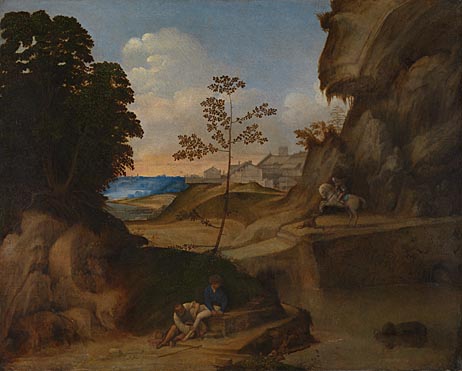
More than optical appearance and painterly fact were at stake, though. As Eastlake acknowledged, there was something effeminate and even cowardly in the endless equivocations allowed by the Venetian technique that stood in firm contrast to the "neck or nothing, irrevocable Flemish method [which] is a far more manly and difficult practice." (Eastlake, Vol. II: 274) Indeed, what emerges from Eastlake's account—particularly as he turns to Venetian masters like Giorgione whose Il Tramonto (ca. 1506-10) we see at left—is an emphasis on dynamic tension between a rocky, masculine art of underpainting in vivifying resistance to the oily, lapping, feminine seas floating on top of it. Giorgione, Eastlake writes:

... would at the same time see the danger of the extreme softness and obliteration of form to be apprehended from this treatment, and therefore the necessity of a proportionate boldness and solidity as its basis. Without the substance and ruggedness of the rock, the superadded cloud, still more softened by glazing, would have wanted contrast of texture and truth of imitation. While therefore adopting contrivances which insured the softest transitions, the most perfect roundness, and the largest breadth, it was impossible for a painter of energetic character like Giorgione not to feel that the utmost vigour and apparent contempt of labour were requisite in the earlier stages of a work in order to conceal the delicate operations reserved for its completion. (Eastlake, Vol. II: 279)

Now, Eastlake goes to some truly extreme measures of violence in his language for communicating the requisite tension between layers. The painter must operate by "beating and stabbing" (p. 283), aiming to "kill the cold colour" (p. 284) and to make sure all blue shadows are "neutralized." (p. 285) It is as if only by these extremes of violence that the Venetian method by Eastlake's account could avoid collapsing into an emasculating, liquid softness—an employment, as Michelangelo supposedly claimed, "fit for women and children." (p. 280)

Given the violence of this language, I can't help but think of Jim Elkins's account of painting-as-alchemy, which we read earlier in the term. It seems highly to the point here: "One of the aims of alchemy ... is to make the volatile fixed: to cut the limbs from the lion, or clip the wings from the dragon, or shear the feathers from the phoenix. The alchemists thought of fixation as hobbling, chaining and mutilation." (What Painting Is, 123) While the violence with Eastlake's Venetians is less fixing volatility than keeping it in productive, rigorous motion, the author was surely cognizant of the alchemical operations at work. "So simple a process as this will banish all ideas of the palette [i.e. of the Flemish, "atomic" method]," Eastlake tells us at one point as he invokes alchemy's transmutational aims: "Evident as the brush-work may be, and ought to be, [it] will transform the mere paint into silver and gold." (p. 285-6)

So, masculine and feminine, under-structure and surface, heat and cold, etc. must all be kept in dynamic tension if the Venetian scheme is to work. But, when it does work, the effect is truly marvelous. And the following are the terms by which Eastlake concludes his study:

The production of various degrees of transparency and of the whole range of warm and cool tints by judicious alternations of scumbling and glazing, is a world which may be said to be at the painter's [end p. 295] command. The art of producing such results may be studied at first merely as an art, and without direct reference to nature. The processes in fact are in a degree precisely those of nature, and therefore can never fail to open up a universe of colour unapproachable by any other means. It need not there be dissembled that the dynamic method considered with reference to colour only, involves completeness in itself, and is so far independent of nature as it is an application of nature's own means. But the power and the capabilities of the system being felt, its possible refinements, with all its accidents, and all its assistance from vehicles and from substance—such as the repeated interposition of colourless media (for which the Italian varnish is adapted) and the production of internal sparkle by brilliant colours half ground, or even by the veiled glitter of metallic particles—all these capabilities being felt, with many more aids from that "cunning" which he has acquired at home, the painter goes to Nature and compares her world with his own. He finds that infinite as the Great Artist is, he too has in his possession a miniature scale of processes which, in conjuring up of magical effects, is analogous to those which Nature herself puts into requisition, and he at once selects and delights in the most difficult of those problems in light and colour which the external world presents to him. (p. 295-6)

As I read this passage, Eastlake's Nature overlaps substantially with that which had brought photography into existence according to Batchen. That is, Venetian painting is a dynamic method that creates its values—indeed, its "magic"—through a quasi-alchemical juxtaposition of male and female, dry and liquid, subterranean and superficial elements brought into dynamic tension. Although the Venetian artist can get lost in that world of his artificial making, it turns out that he is already in the world because Nature and her processes are structured like his dynamic painting method. Now, if we recall that Eastlake was centrally involved with both painting and photography ca. 1850—he became President of the Photographic Society in 1853 and the first Director of London's National Gallery in 1855—some interesting questions emerge. Is it too simplistic to say that where the painter's "cunning" had to be used to craft juxtaposition between elements to create a dynamism equivalent to nature, the photographer's intelligence aimed to bring nature's flux to a halt? If Venetian painting had long been likened to Nature, is Eastlake's emphasis on dynamism new to both (as Batchen would have us believe at least for the latter)? And what are we to make of all this talk of alchemy, cunning and magic? Fascinating!


Tuesday, February 14, 2012

Fossils, Photography, Painting

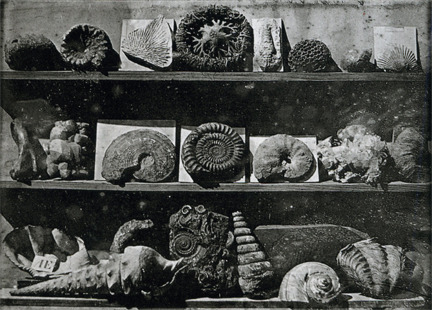
In his contribution to Jim Elkins's volume Photography Theory, literary critic Walter Benn Michaels takes a claim from Hiroshi Sugimoto (whose Devonian Period, gelatin silver print of 1992 we see at left) whereby photography stands in some meaningful relation to fossils. Neither are, so this claim goes, only  representations. And perhaps, as Michaels suggests, neither are representations at all. Fossils and photographs are both made from objects such that those replicated targets become "causally indispensable" to the resulting petrification or chemical image in ways that are simply irreconcilable with pictorial techniques like painting. (Michaels, 432) While a broader aim of this course is to problematize the model of photography that Michaels has in mind, the preliminary question for today is: what does this assertion assume about fossils? More to the point, following on from what we saw last week with Boschini and his delight in the distance of Titian's stains and marks from intentionality, how plausible is the conception of painting to which Michaels is juxtaposing his conception of the fossil/photo?

As a way into those questions, we began with two early modern texts on those artifacts we know now as fossils. For Nehemiah Grew (from whose Musaeum Regalis Societatis [1681] the images at left are taken), Michaels's contention that fossils need some prior object to transform would have been highly tendentious. While he acknowledges that it is fashionable to claim that fossils are natural bodies petrified, Grew also asks: why might we not imagine that that Nature has redeployed the "plastic virtue" by which terrestrial bodies are normally formed, but done so in the colder, wetter bowels of the earth for fun? (Grew, 254) After all, if comparable techniques of embedding "pictures" into stones could be practiced by contemporary artisans (as the piece we read from the Philosophical Transactions of the Royal Society of London shows) and if so-called fossils could be dissolved in acid (Grew, 267), then surely the higher artifice of Nature could produce these marvelous sports. Grew puts it this way: "There can be no convincing Argument given, why the Salts of Plants, or Animal Bodies, washed down with Rains, and lodged under ground; should not there be disposed into such like figures, as well as above it? Probably, in some cases, much better, as in a colder place; and where therefore the Work not being done in a hurry, but more slowly, may be so much the more regular." (Grew, 254) 
  
Contra Michaels, then, objects in the world only appear to be "causally indispensable" to fossil-production. In fact, Nature  is just playing games—an idea with an extensive early modern pedigree. Curiously enough, though, Grew also goes on to compare the manner by which these "pictures" of natural forms get embedded into rock with what he calls images "cast through a Glass (as Kepler shews the way sometimes of taking Landskips) upon a Tablet in a Dark Room." So as with Michaels, we might say, Grew ends up likening camera-(obscura)-based image-making to fossils anyway. 

Contemporary to Grew, Robert Hooke took a radically different position on fossilization. The sea shells found on the tops of mountains were, he contends, once lay at the bottom of oceans. (Hooke, 324) If incredibly hard rock like flint was once so fluid that it could envelop shells, then the earth must be massively susceptible to radical changes. Indeed, Hooke continues, a model of the created earth organized around the governing influence of gravity would be an onion-layer system with the densest metals at the core and lighter materials grouped like-to-like progressively outward toward the periphery. This, Hooke explains, is why gold is so often found in mountains, where the forceful violence of earthquakes has forced subterranean materials upwards. Unlike Grew, then, there is no space for nature to playfully represent her standard form in the cold, wet space of the earth; indeed, the earth is not cold and wet at all for Hooke. Instead, the reason that we find fossils like the ammonites at left is that they have been petrified and then thrust into the earth through Nature's convulsive violence.

Thomas Willis's conception of the means by which the material body and the incorporeal soul communicate are among the closest engagements with "liquid intelligence" to be found in the seventeenth century. Drawing from optics, alchemy, mechanics and extensive anatomical research, Willis explains how the blood is heated and rarefied into animal spirits, then blown upward like a fountain through the fleshy folds of the brain. Unlike chemical liquids, though, the animal spirits can carry with them representational information ("Images of their Objects") by which the faculties of the soul are informed of data perceived by the senses. And these swirling liquids interface with the soul in a truly remarkable piece of visual projection in "the inferior Chamber of the soul, glased with dioptric Looking-Glasses; in the Penetralia or inmost parts of which, the Images or Pictures of all sensible things, being sent or intromitted by the Passages of the Nerves, as it were by Pipes or strait holes, ... are represented upon the Callous Body [of the Brain], as it were upon a white Wall; and so induce a Perception, and a certain Imagination of the thing felt." (Willis, 24-5) So, the blood is filled with images which the soul can see once projected onto or through the hermetic glass casement that surrounds its seat in the watery depths of the brain. Because these images are then saved by the soul, they become the basis for rational thought and reflection. 

Photo-sensitivity is central to the accounts of William Petty and William Cole, who also links it to fossilization. Petty begins his account of dyeing (published in Thomas Sprat's 1667 History of the Royal-Society of London) by emphasizing how central to the study of light would be to any exhaustive understanding of liquid dyeing practices. (Sprat, 284-5) Petty then goes on to demonstrate how material supports need to be prepared to receive dye (see Sprat 290), and much work is required "to fix" the dye's coloration. (Sprat, 302-3) Cole, meanwhile, takes a delight as much in his capacity to fix color as to observe its temporal evolution. In his correspondence on shell-fish dye from the mid-1680s, Cole sets out a complex account of the times of year when the dye can be fashioned—the season in which the shell-fish can be harvested and how long their innards need to be exposed to the sun to make images. (Cole, 233) He takes great delight in juxtaposing fossils (a specimen of which he claims "will puzle Mr. Hooke and the rest of the ingenious Gentlemen who will have them to be petrified shells of fishes"), which seem to be painted by Nature (along similar lines as that of Grew), with his photosensitive dye, which is painted by hand but then transformed by the sun.

What can we conclude from all of this? Well, first off, Michaels certainly moves in a venerable tradition when he likens camera-made images to fossils. Whether or not objects "cause" their images to be made in either domain, a central theme in this collision holds that human agency or intentionality is somehow put into abeyance when these visual forms are generated. Nature is playing games. Or, if a human intervention is required to ready a chemical support or to provide an optical projection, it is the sun that then does the work in making an image appear in time. Now, if all this flies in the face of the ideology of artistic nobility promoted by Poussin—if this solar agency departs from the dark, sunless spaces commanded by the masterful maker of oil painting in van Mander's narration of Van Eyck—it seems to how close to the model of Titian's painting and period reception described by Philip Sohm. "Venetian painting," as Sohm puts it, describing Marco Boschini's views, "is a 'form without form, or rather form deformed'; it finds its 'true formation in fluid form.'" (Sohm, 124) How, then, do we explain this persist conception of painting (to which Michaels clearly subscribes; see 444) as a pure exercise of human will and intentionality whereas photography—like fossilization—is mired in a quasi-magical domain of objects that make their own images?